All posts by janicezindel

Pardon Our Dust!

There is activity going on in the studio, and it is not weaving!  The floors have been badly in need of refinishing, improved lighting has also long been needed, and a couple other changes are also being made.  It is exciting to, at long last, see improvements being made!

Rough board wall was removed.

Behind this bookcase was a “wall” made of several rough-sawn boards, put up by the previous owner to keep his children from climbing up onto the bookcase and falling down to the basement floor (basement stairs go down there).

New "half wall" was built.
New “half wall” was built.

In its place a “half wall” was built which happily has made the studio feel more open.  Light switches were put in this wall as well as an electric outlet on each end.  The bookcase will be relocated elsewhere in the room.  An added advantage is more warmth from the woodrange will reach into the studio.
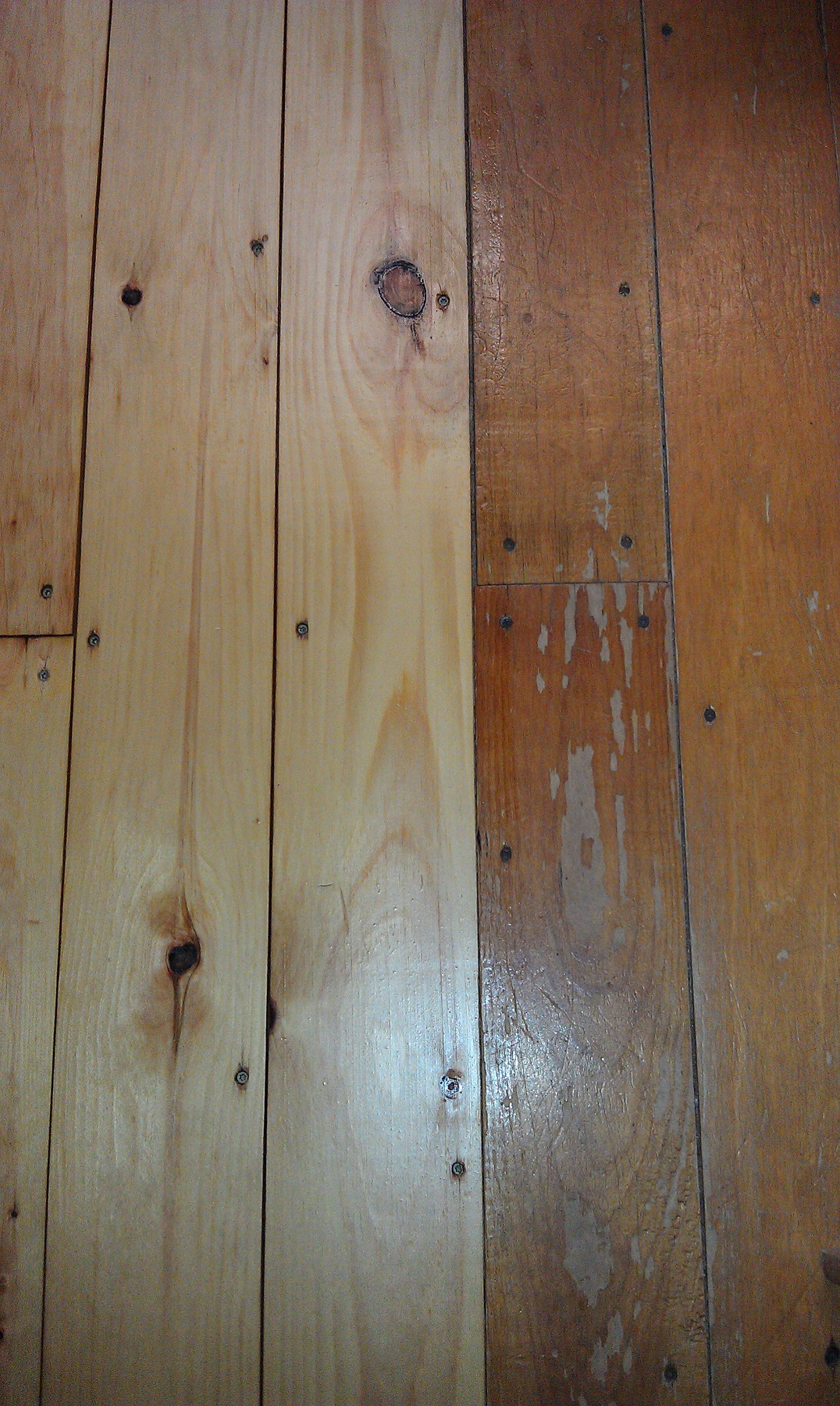
Old floor (right) and newly refinished floor boards (left).

Three families over 22 years along with two large dogs took a toll on the floor boards and they were in sad shape. They are being taken up, the finish sanded off, then run through a planer and put back down, followed by application of two coats of stain and two coats of finish.  We decided to go lighter to lighten up the rooms, and because over time, the boards will darken anyway.
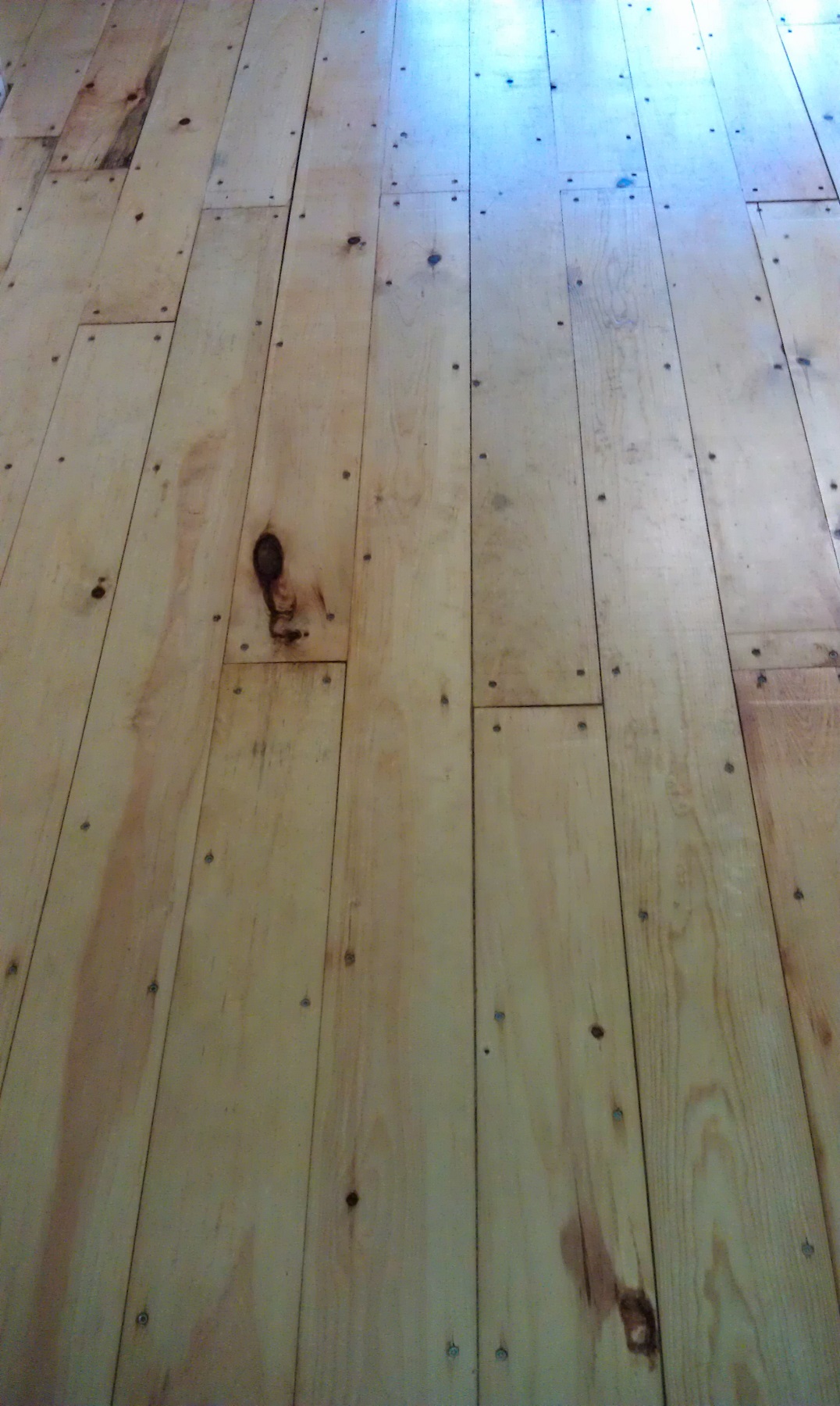
Newly finished section of the floor.

It is not possible to move the large Glimakra looms out of the studio, so the floor is being done in sections, and looms and bookshelves being moved as needed.
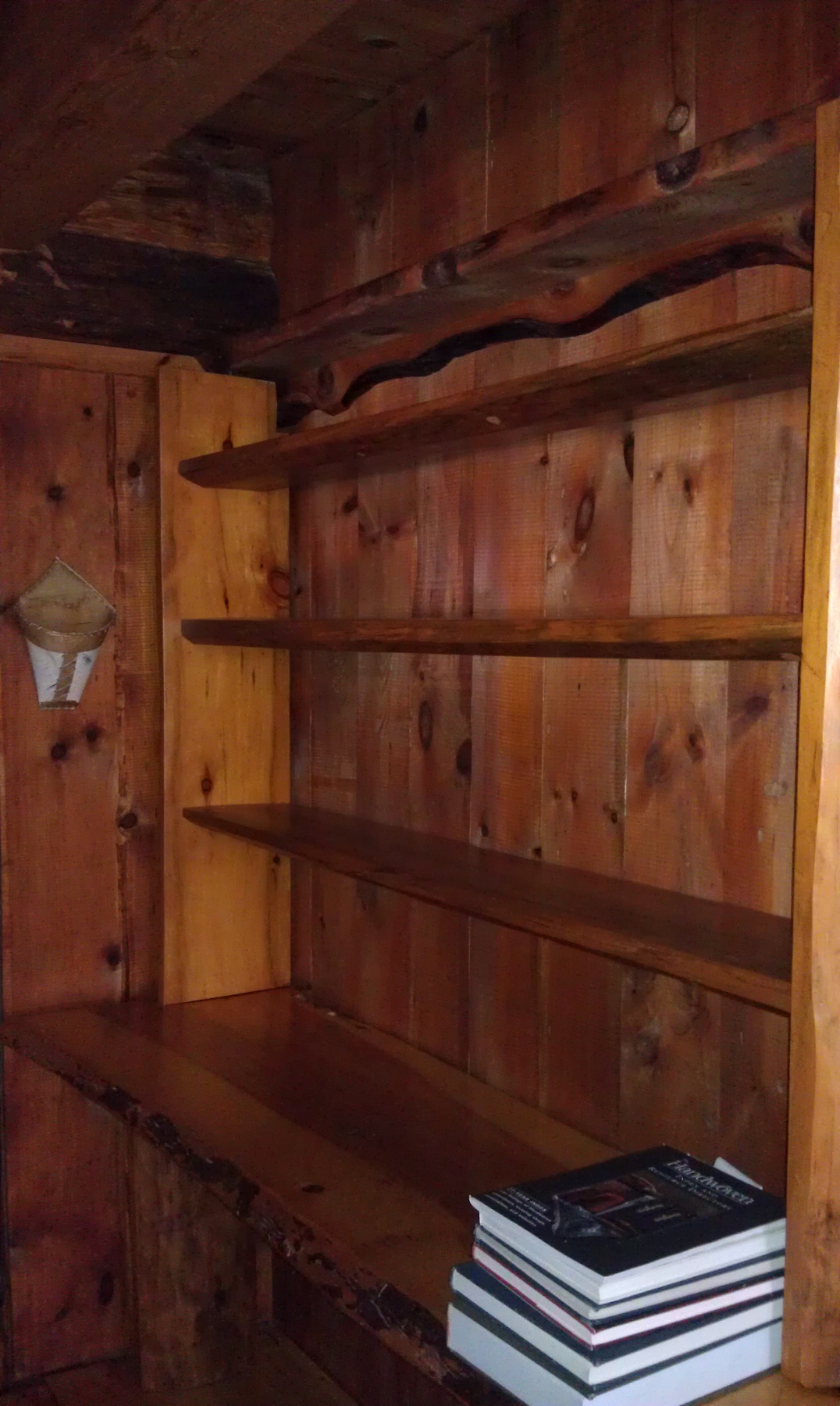
Another bookcase was moved, temporarily.

My entire weaving library had to be moved out of the studio so this bookcase could be moved, in order to take up floor boards.  Whew! What a heavy job that was!  I carried them in stacks out to the kitchen, filling the kitchen table and part of the island.  It’s a good thing the table is as thick and strong as it is, anything else might have collapsed!
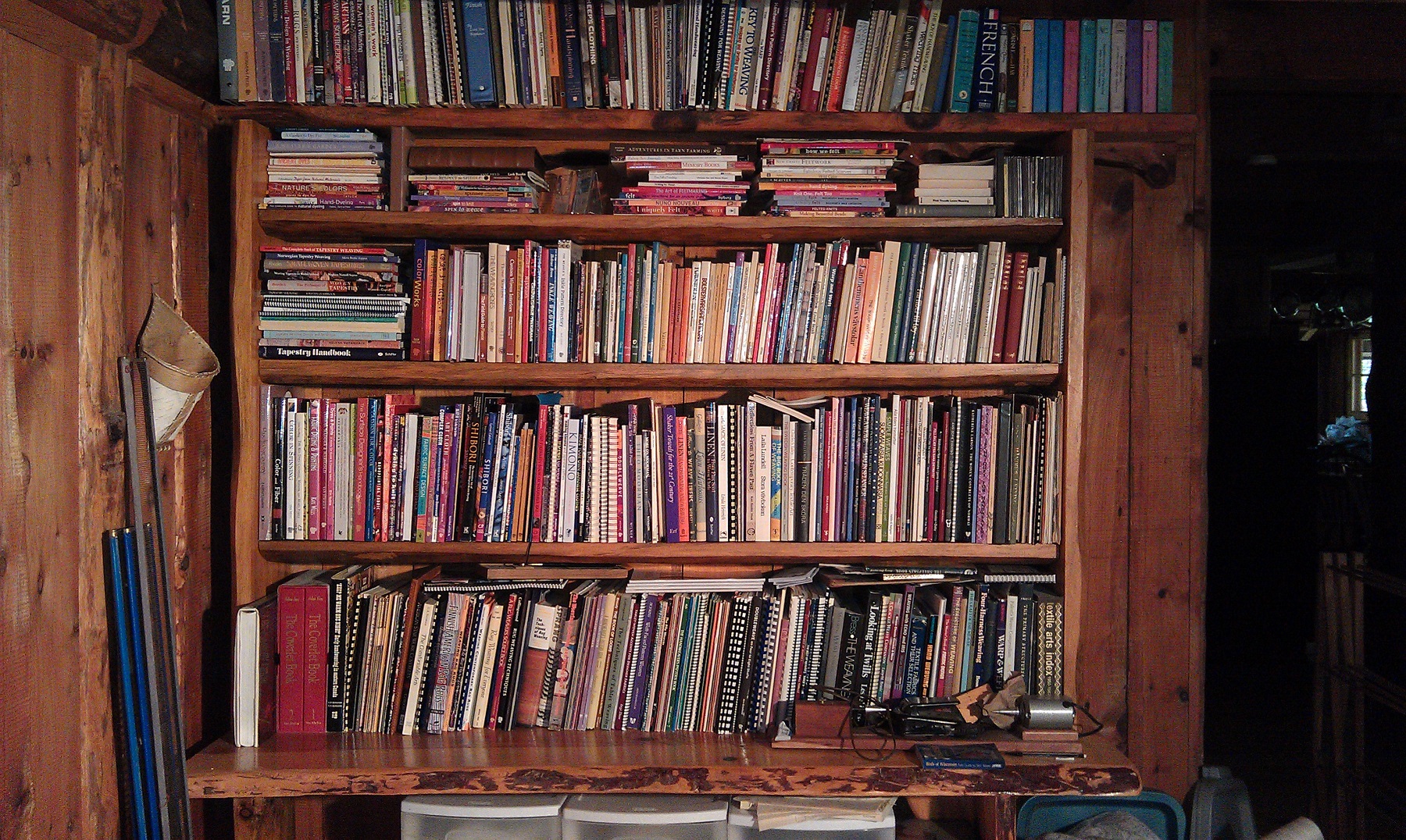
Weaving/fiber library back in place.

Most of the weaving library is now back in place, and organized.  Larger notebooks of materials are still packed in boxes, waiting for the other bookcase to be set in its new location.
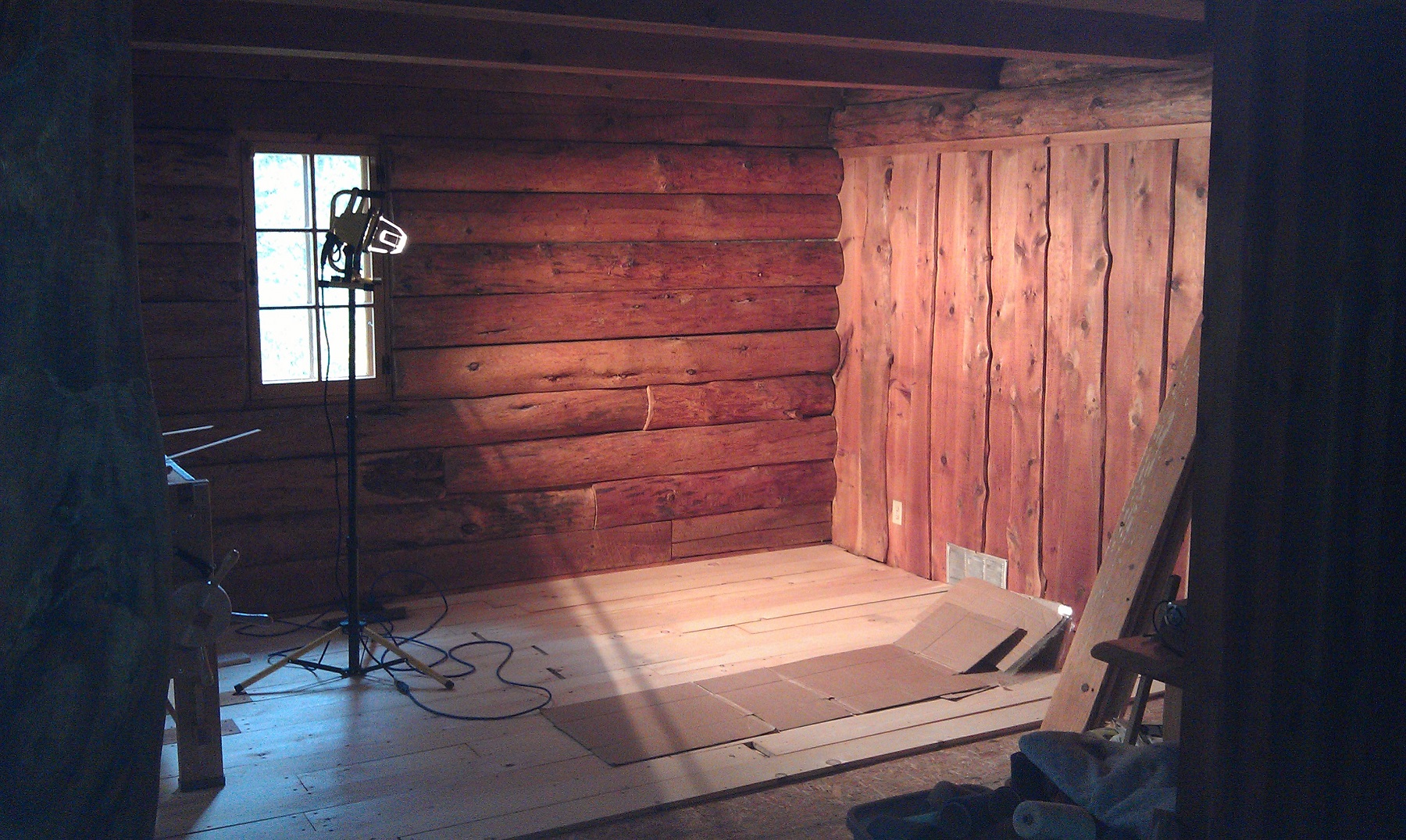
Wall-washing, too!
Wall-washing, too!

Since this half of the studio was emptied, I took the opportunity to wash the walls.  Dust accumulates from woodburner, pets, and open windows (pollen and dust).  Looking better now!  I recall author Helen Hoover writing about washing log walls, and she commented on how the area is increased when washing a “corrugated” surface!
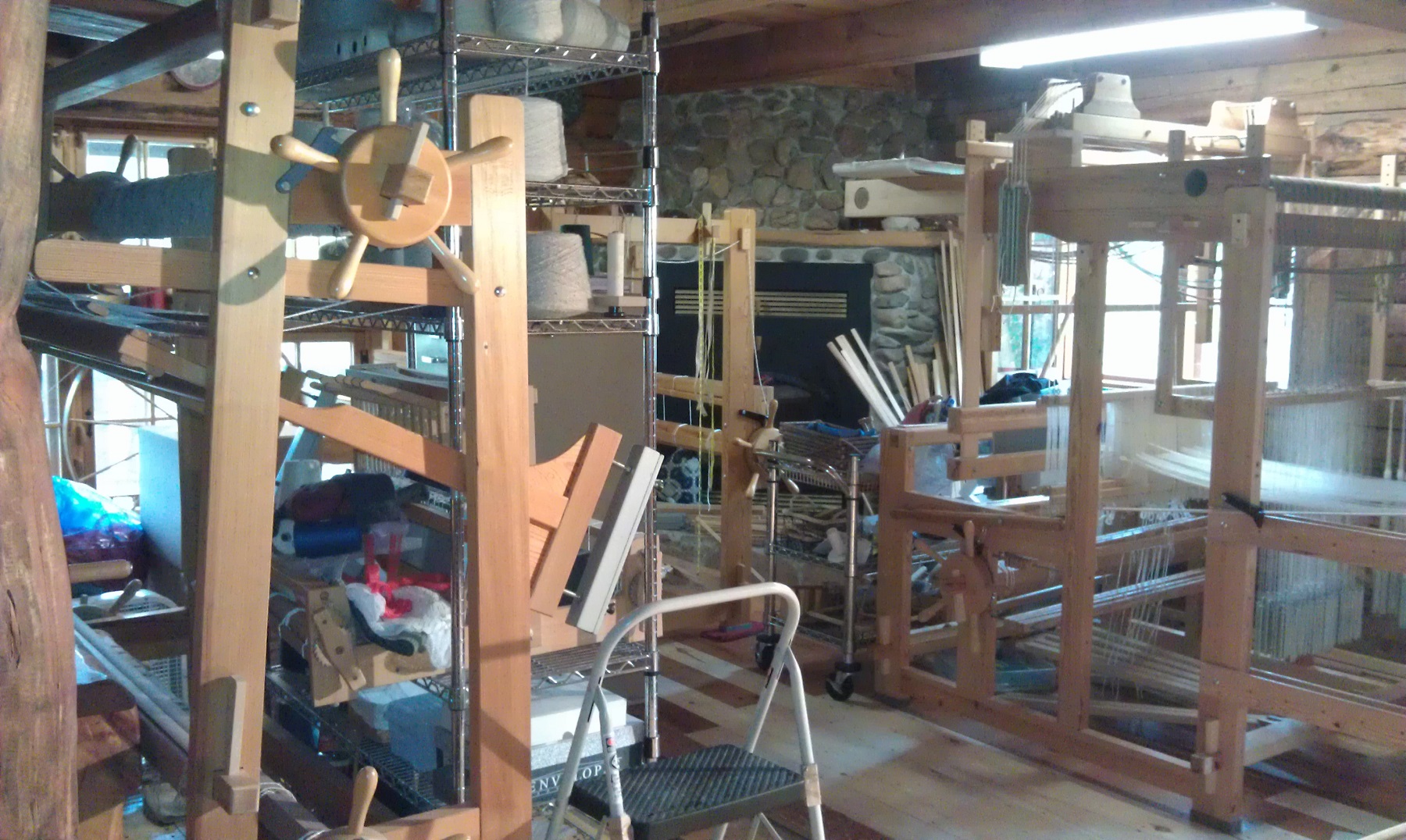
Looms and more pushed to one end of the room.

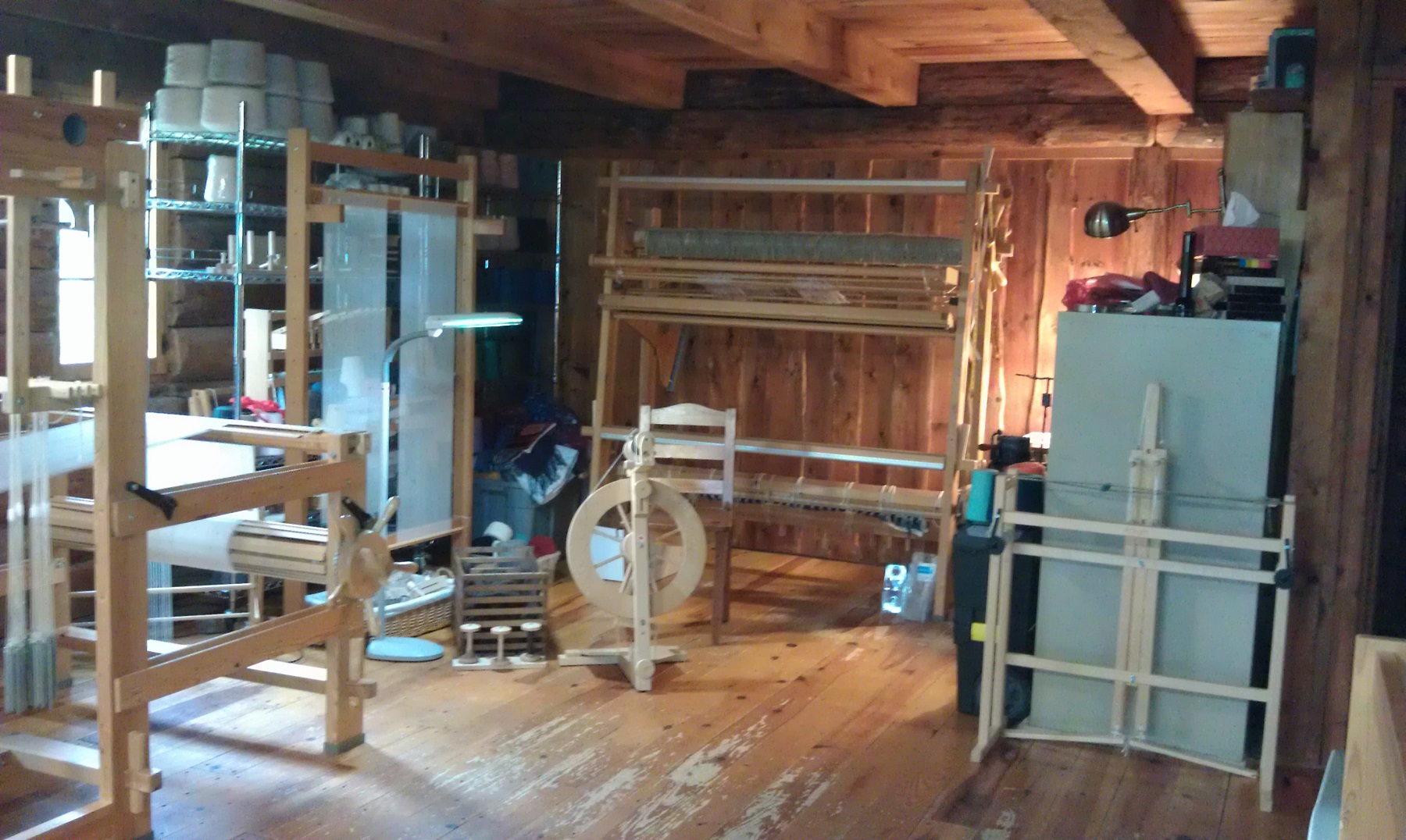
The Glimakra Regina, Sara tapestry loom (not visible), boxes, bins, file cabinet, and more were pushed into one end of the room so floor boards could be taken up.  In a couple days, all this, including the drawloom, must be moved to the area now clear, so the remainder of the floor can be done.
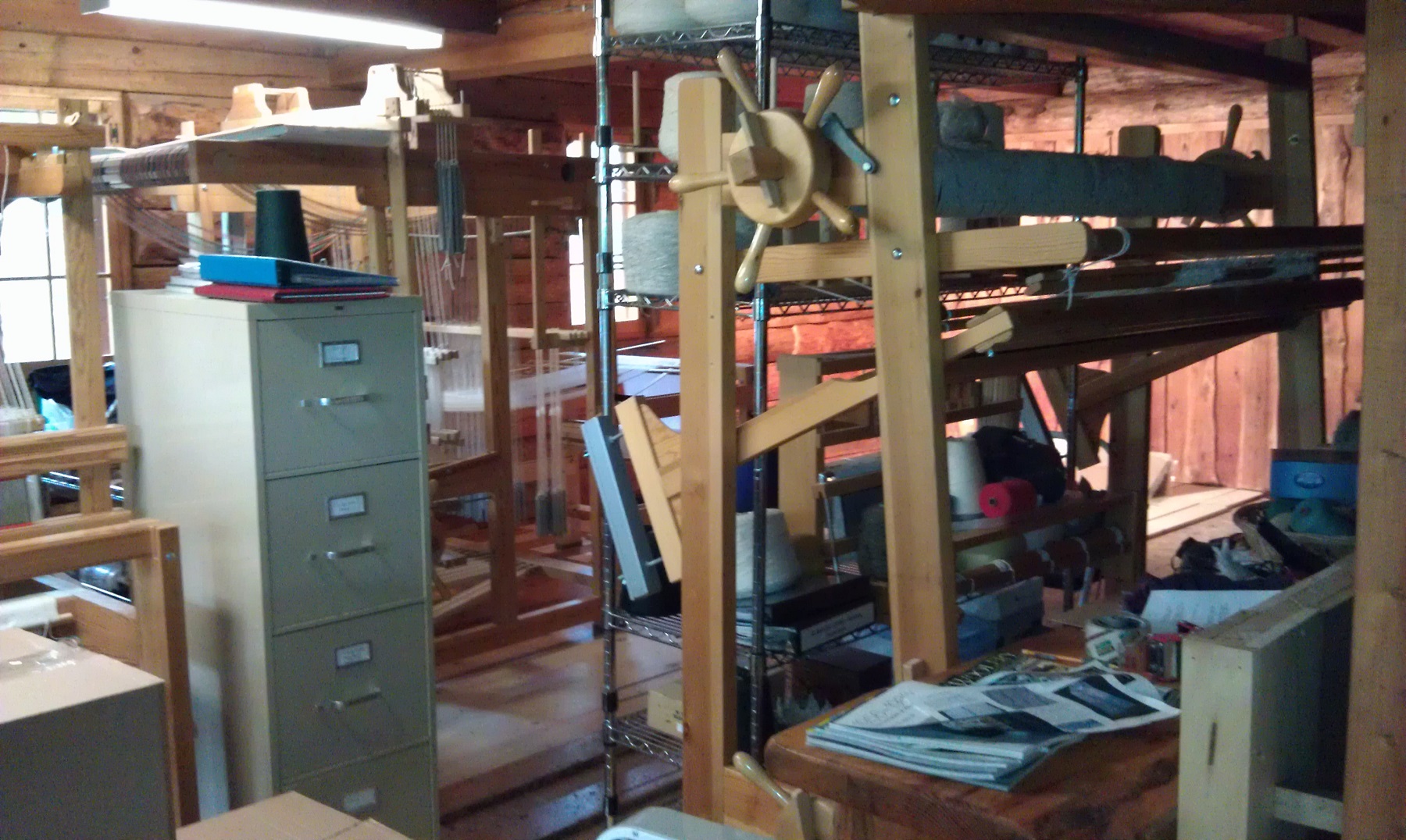
No access to looms at present.

Looms are not accessible this week, and though I’m very happy this work is being accomplished, I’m also a bit frustrated.  I’m taking the time to consider a new arrangement of the looms, and of additional lighting that will be installed in a few days.

The Fall Art Tour is coming up fast along with other events and I need to weave!  Meanwhile, I can make warps – I made sure the warping mill and tube holder are accessible, and the sock machine is upstairs ready to use.
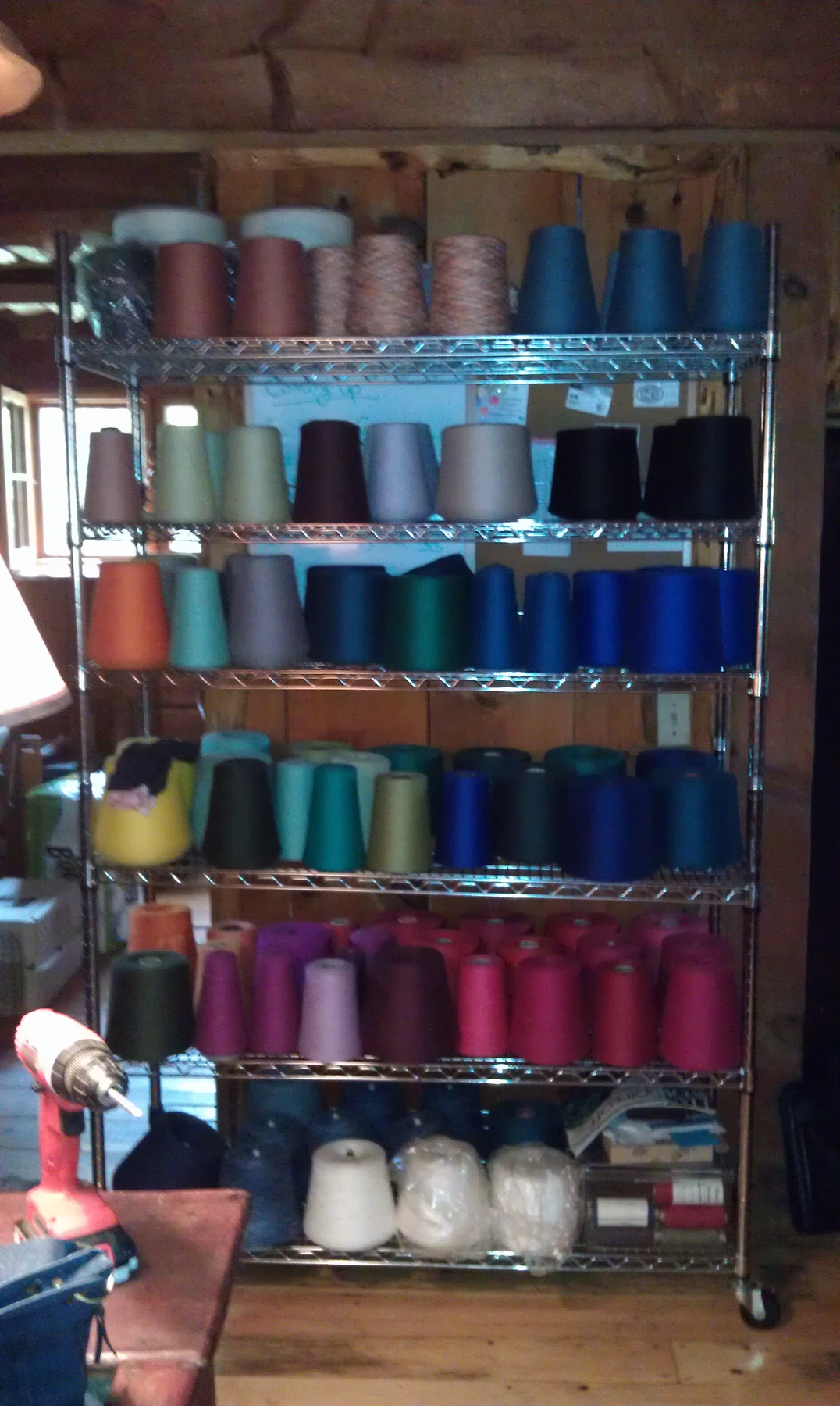
Sock yarns are accessible so I can get some work done.

I also made sure the sock yarns are accessible, and that is what I’ll be working on until I am able to get back to the looms, hopefully by Monday.

Coming up,… October 4th, our guild has a demonstration date and also sale of our weaving and other fiber work, held during CranberryFest weekend in Eagle River, WI.

Oct. 6-12, National Spinning and Weaving Week, and having lost my mind awhile back, signed up to participate in Spinzilla that week.  Lost my mind because it is also during,…

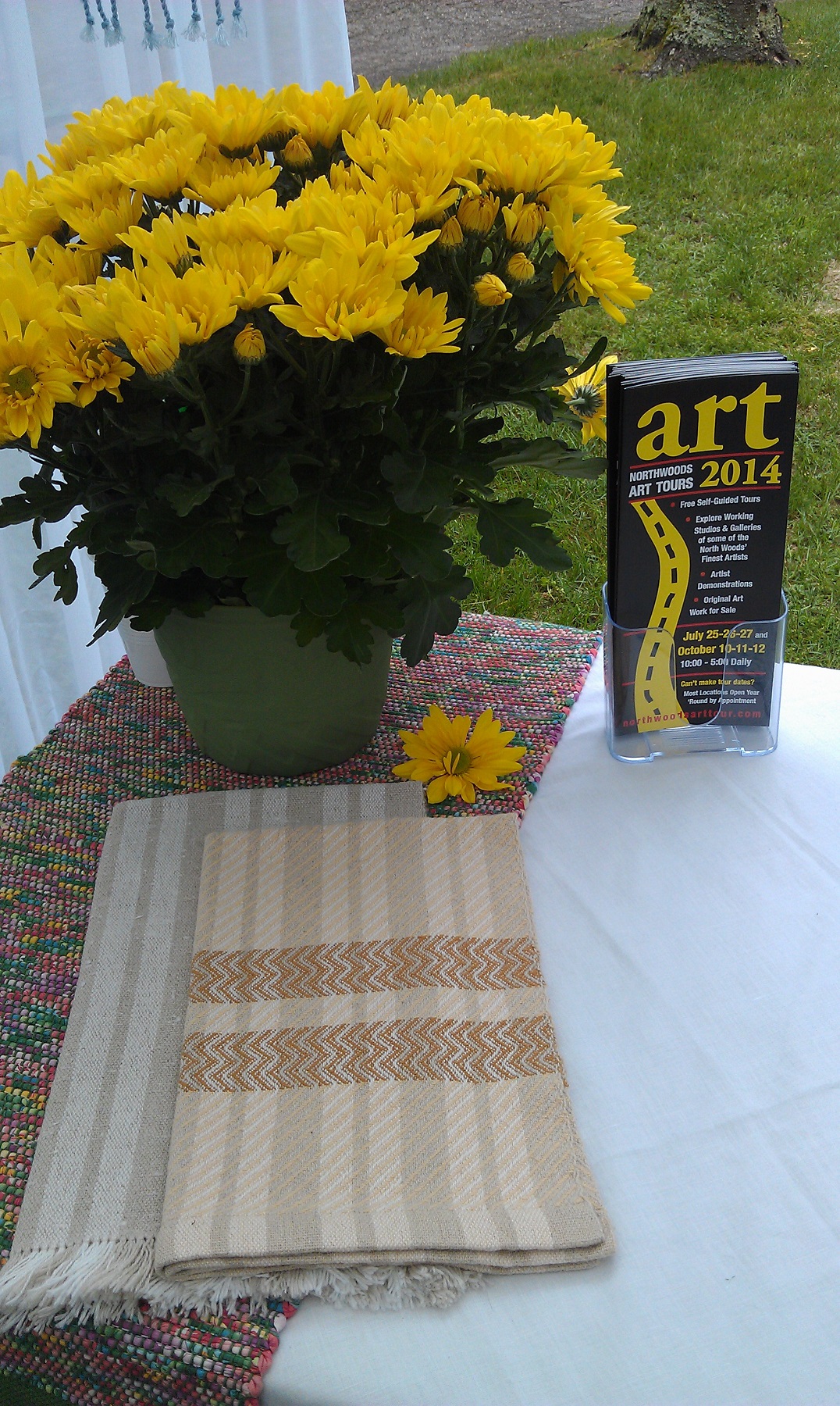
Oct. 10-12 – the fall Northwoods Art Tour!  If you are in the area, I encourage you to pick up a brochure and go visit some of the area artists studios!

Nov. 15 – Northwoods Artisans Holiday Open Studio, here at Shuttle Works Studio, Heirloom Custom Wood Design, and Celtic Wolf Studio.  Weaving, woodworking, and jewelry for sale and visit with the artisans!

I’m looking forward to the new studio layout, meanwhile, I must get back to making socks!

Autumn Begins

Yesterday was the Autumn Equinox, and the beautiful northwoods of WI now has beautiful color.

Just down the road, on a sunny day.
Great color against the pines.


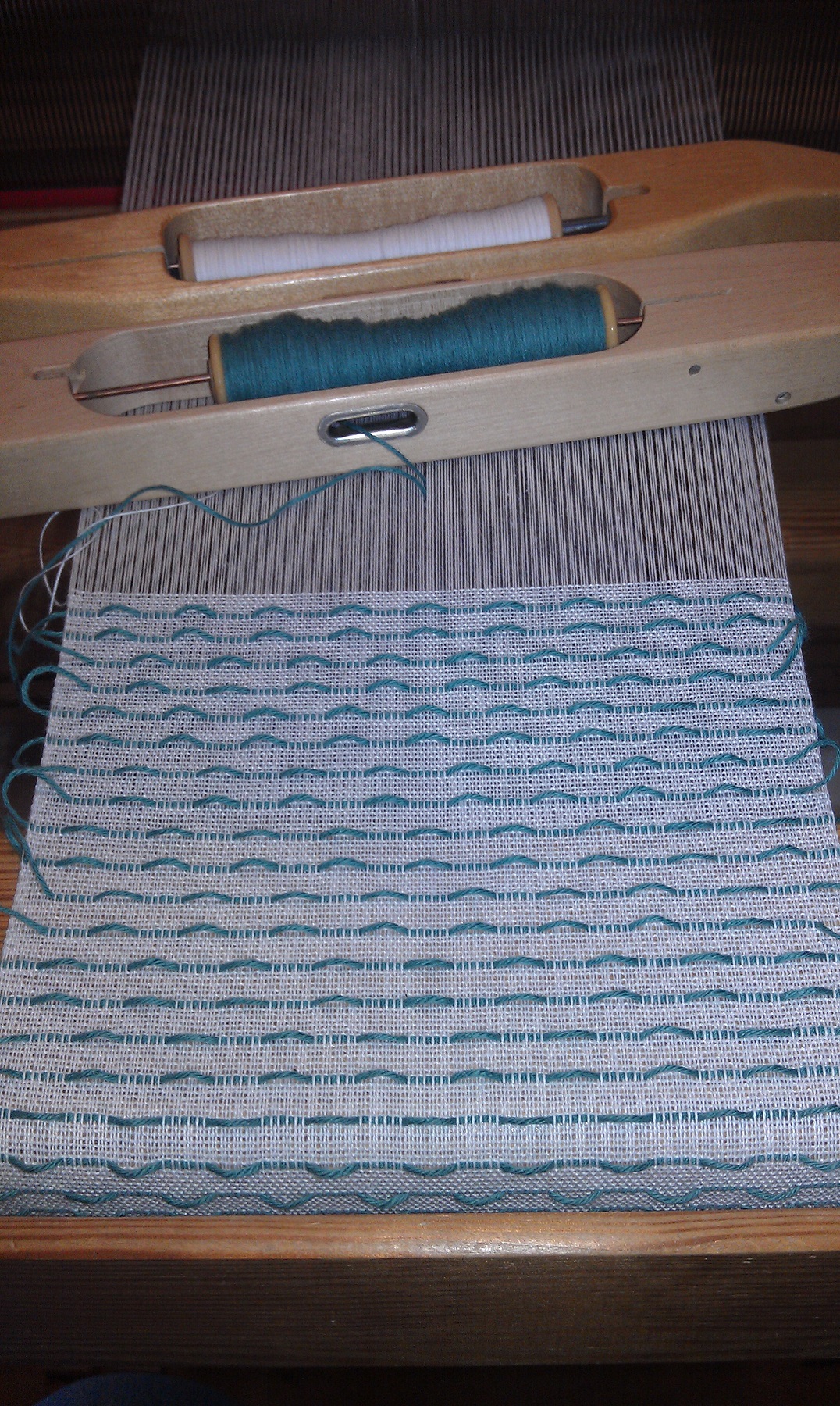
Woven shibori on the loom.

Meanwhile, I continue with woven shibori scarves since all but one were sold during the art tour.

The end of the warp was finally in sight!

It’s always good to see the number of warping sticks go down!

Warp completed, weaving off the loom.

I was hoping for three scarves and another long piece that would, after dyeing, be cut up and used for smaller items.  Unfortunately one of the scarves had a one row treadling error which I did not notice until after dyeing.  Happily, my daughter wants it and does not mind.

Time to gather and tie.

The next part of the process is to gather and tie, as tightly as possible, the “pattern threads” which are removed after dyeing.

Drying outside.
Drying outside.

The pieces were left to dry outdoors for a few hours, then brought inside.  They are not opened until dry, or nearly dry if I cannot wait to see the results.

Crinkly when first opened.

Due to the tight gathers, when first opened the scarves are quite crinkly, reminding me of collapse weave.  However, the scarves must be washed and well rinsed to remove any dye not attached.

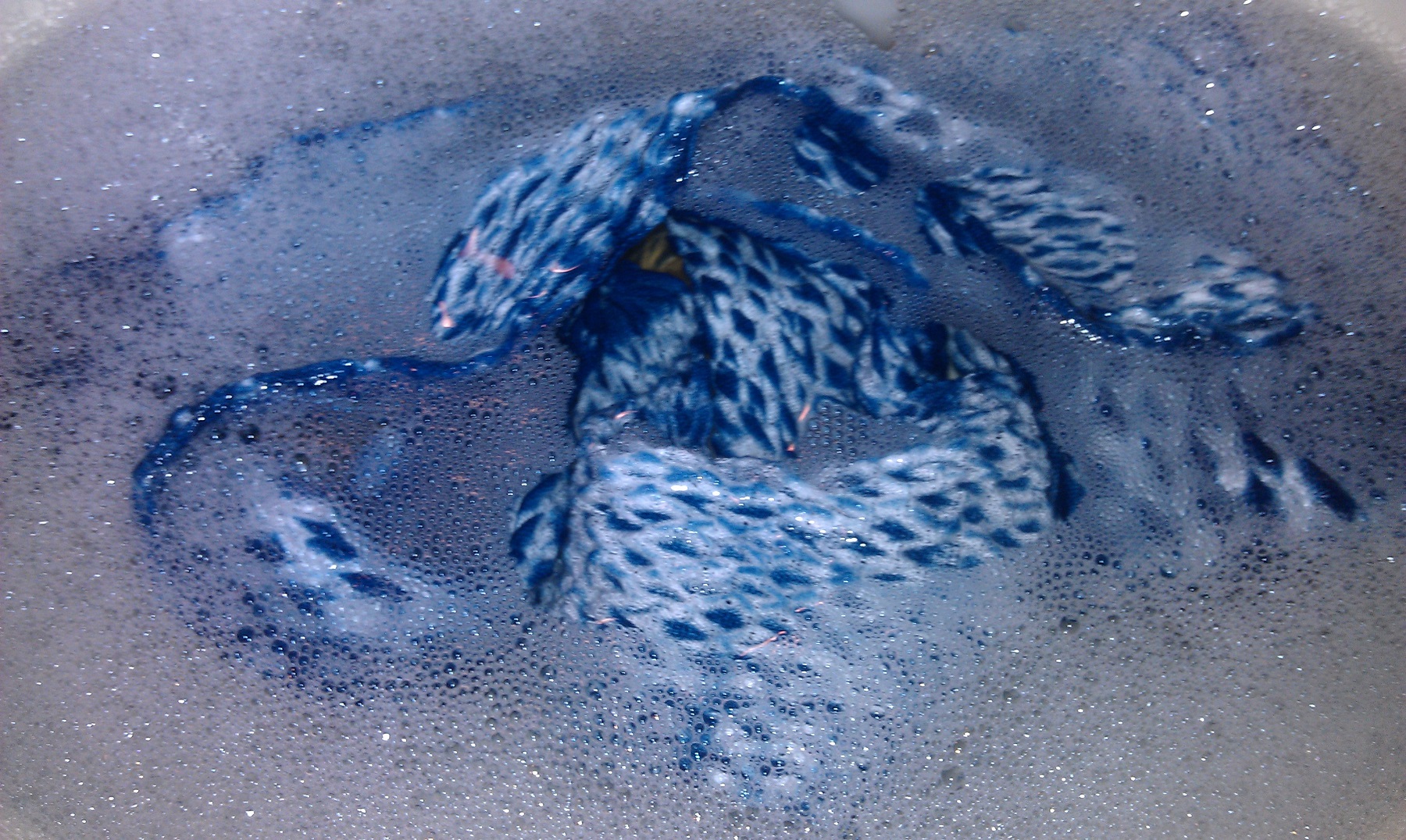
Finishing begins.
Finishing begins.

Scarves are hand-washed in a mild soap, then repeatedly rinsed until the water is clear.  After air-drying they are pressed and fringe is hand-twisted.  The results are,…

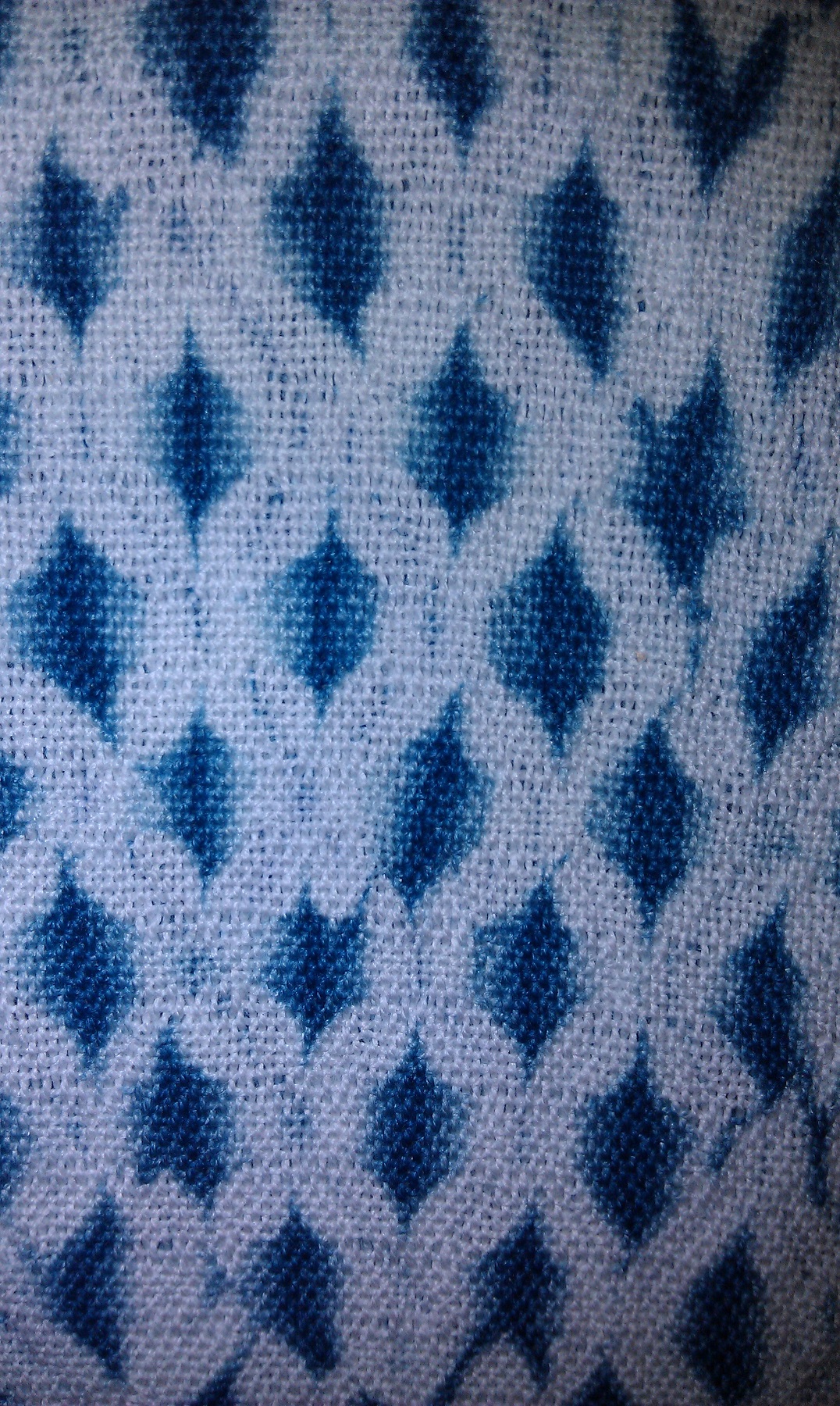
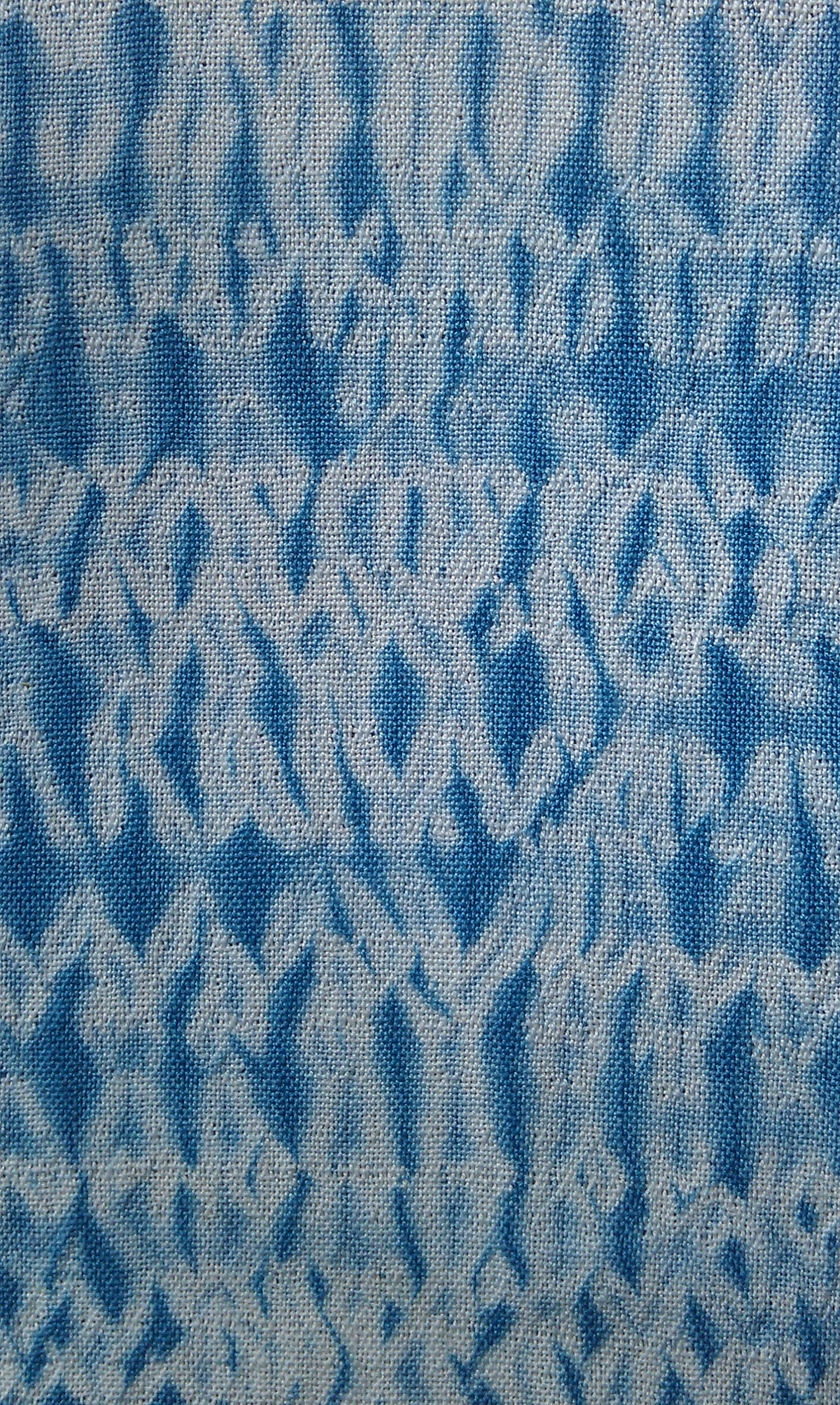
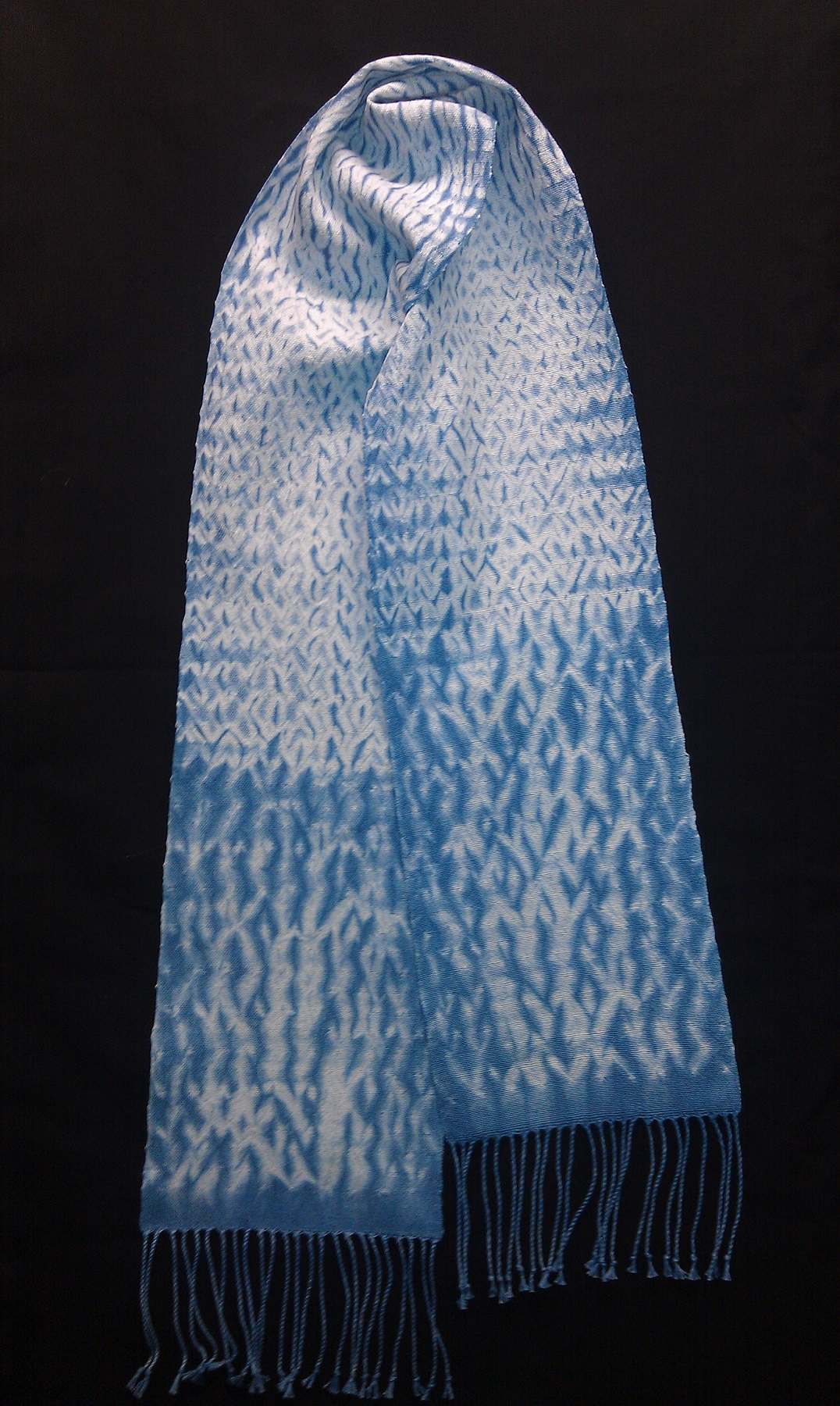
Beautiful, one-of-a-kind woven shibori scarves.
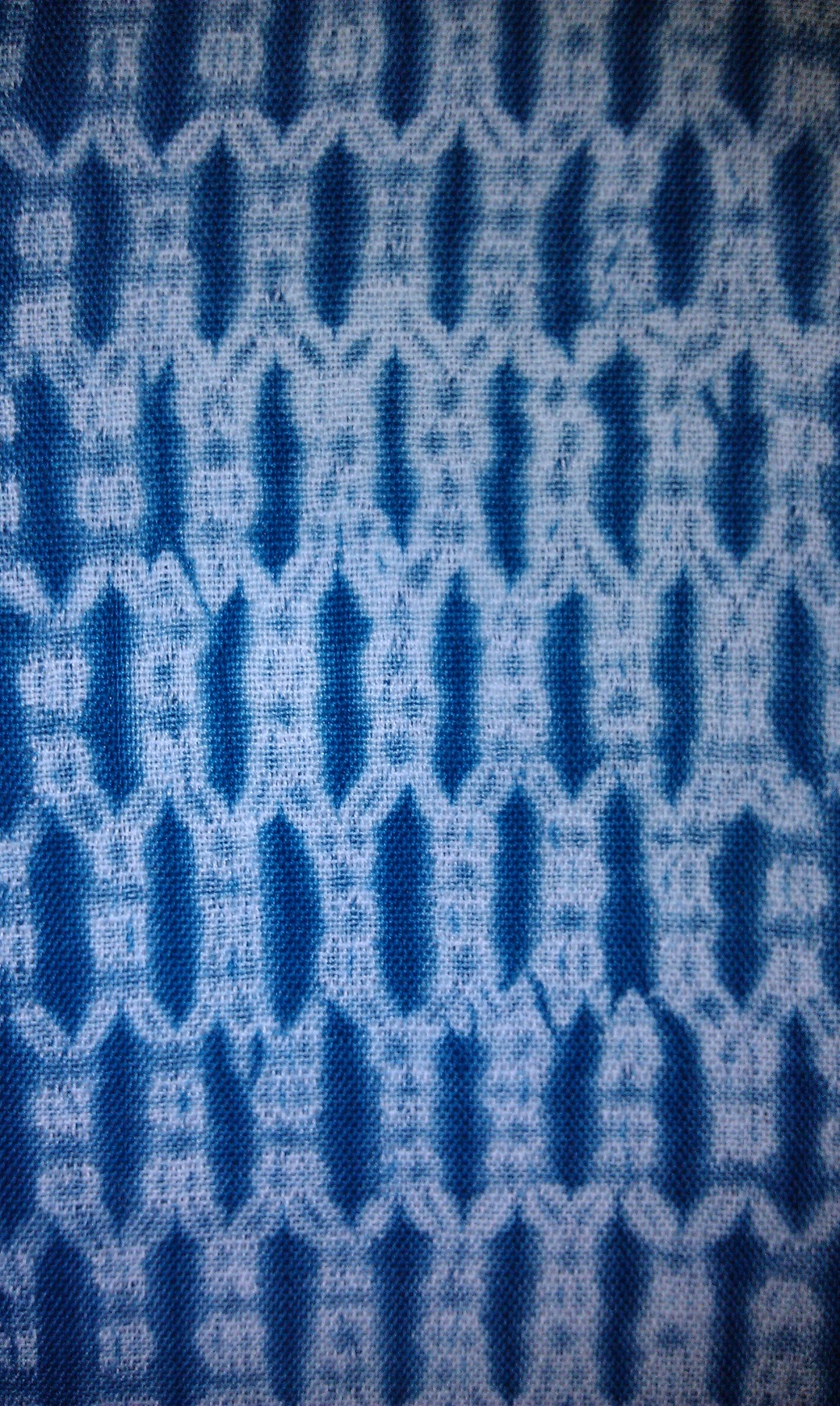
Unique!
Unique!

The goal is for each scarf to be unique.  One more warp and it will be time to explore new ideas.

Northwoods Art Tour 2014

Woven shibori in progress.

Above is a woven shibori scarf, 4 shaft Monk’s Belt.  I enjoy creating one-of-a-kind scarves by varying the treadling on each one.

Hemstitching on the loom.

I am hemstitching these scarves on the loom.  Normally I would break up the threading to avoid reed marks, but leaving it has been useful when hemstitching 3 threads in each group.

Two recent scarves.
Two recent scarves, variations on a theme..

Both of these scarves are from the same warp, same threading, and were treadled differently for different results.

Glimakra Regina rug/tapestry loom.

I’m back at work, getting the Glimakra Regina rug/tapestry loom ready to be warped.  Heddles and cords were given the “spa” treatment, heddles were clipped apart, and put on two shafts.   The shafts were then fastened to the loom.  All that is left is to add the treadles, remove remnants of the old warp, make a new warp, and beam/thread/sley it.  And then WEAVE!

It was time to declutter and clean the studio for the summer Northwoods Art Tour.

Northwoods Art Tour banner near the entry.


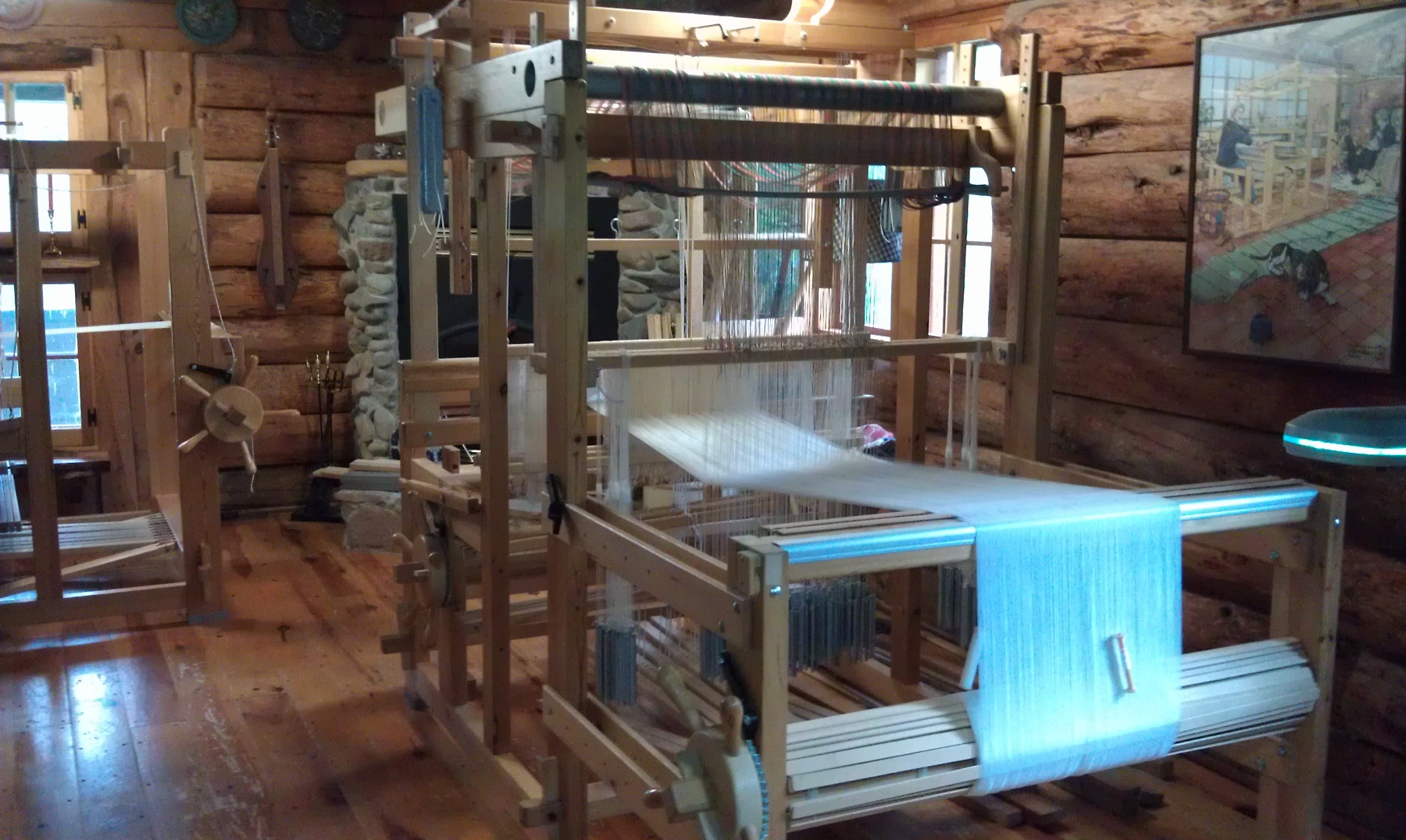
Studio, with Glimakra Standard.

Studio, with Glimakra Standard.

The studio was decluttered, books shelved, cones of yarn put in order, weaving displayed.  The Glimakra Standard had woven shibori in progress, along with a scarf that had been indigo dyed and still gathered and tyed, with only a few knots removed to show the resulting fabric as a demo.

Single unit drawloom.

The Glimakra single unit drawloom had demo weaving in progress.  It was rather frustrating to weave on as the humidity was so high warp threads were sticking together, making it difficult to get a clear shed. Visitors found the loom fascinating.

Another view.
Another view.
Glimakra Regina and band loom.

The north end of the room was set up for more demos – band loom, spinning, and the 1908 Gearhart sock machine.  Many wanted to see everything in action.

Demo weaving on the drawloom.

Despite the threads sticking due to high humidity, I was very pleased with the “landscape” effect of the variegated yarn I decided to try that first morning, and I’ll be working with that more.

Chatting with art tour visitors, sharing my love of weaving and fiber arts, and answering questions is always a pleasure.

Shuttle Works Studio sign .
Shuttle Works Studio sign.

And now it is time to start preparing for our guild demo/sale event, October 4th, during CranberryFest weekend; the Fall Northwoods Art Tour, Oct. 10-12, and our first annual Northwoods Artisan Women Open Studio/Holiday Art Show, on November 15th.  There is a lot of weaving to be done and socks to be made, wonderful hours in Shuttle Works Studio.

Weaving & Art Gypsies in June

New 16/2 cotton warp.

June 1st began with making a 14 yard warp of 16/2 Bockens cotton for more woven shibori scarves.  New threading was 4 shaft Monk’s Belt, sett 30 epi.  Varying treadling allows one-of-a-kind scarves.

Hemstitching on the loom.

Previous scarves were hand-hemmed, or had hand-twisted fringe. On this warp, I decided to hemstitch on the loom.

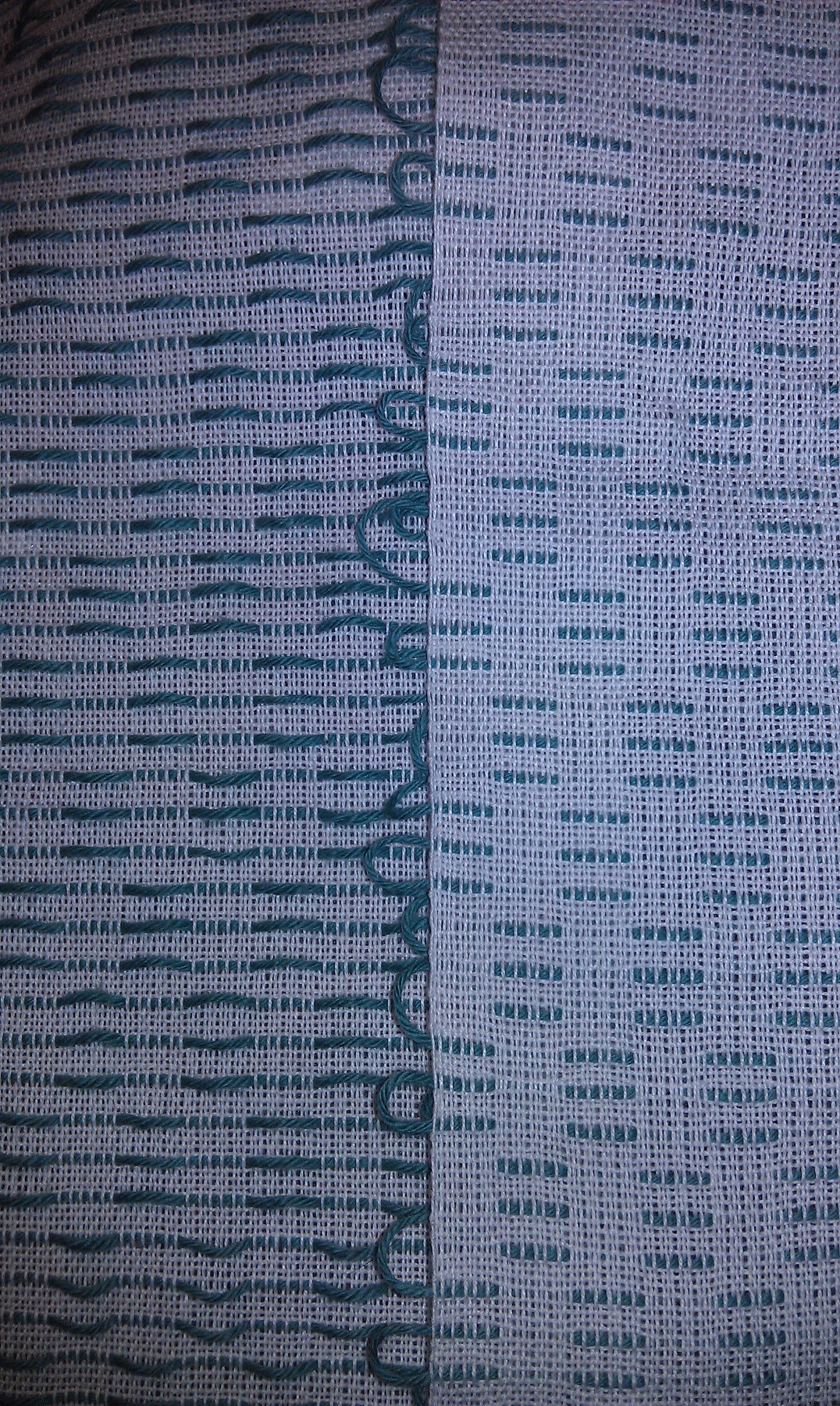
Front and back of scarf.

The above photo shows the front (left) and back (right) of a newly woven scarf, off the loom, prior to gathering and tying.

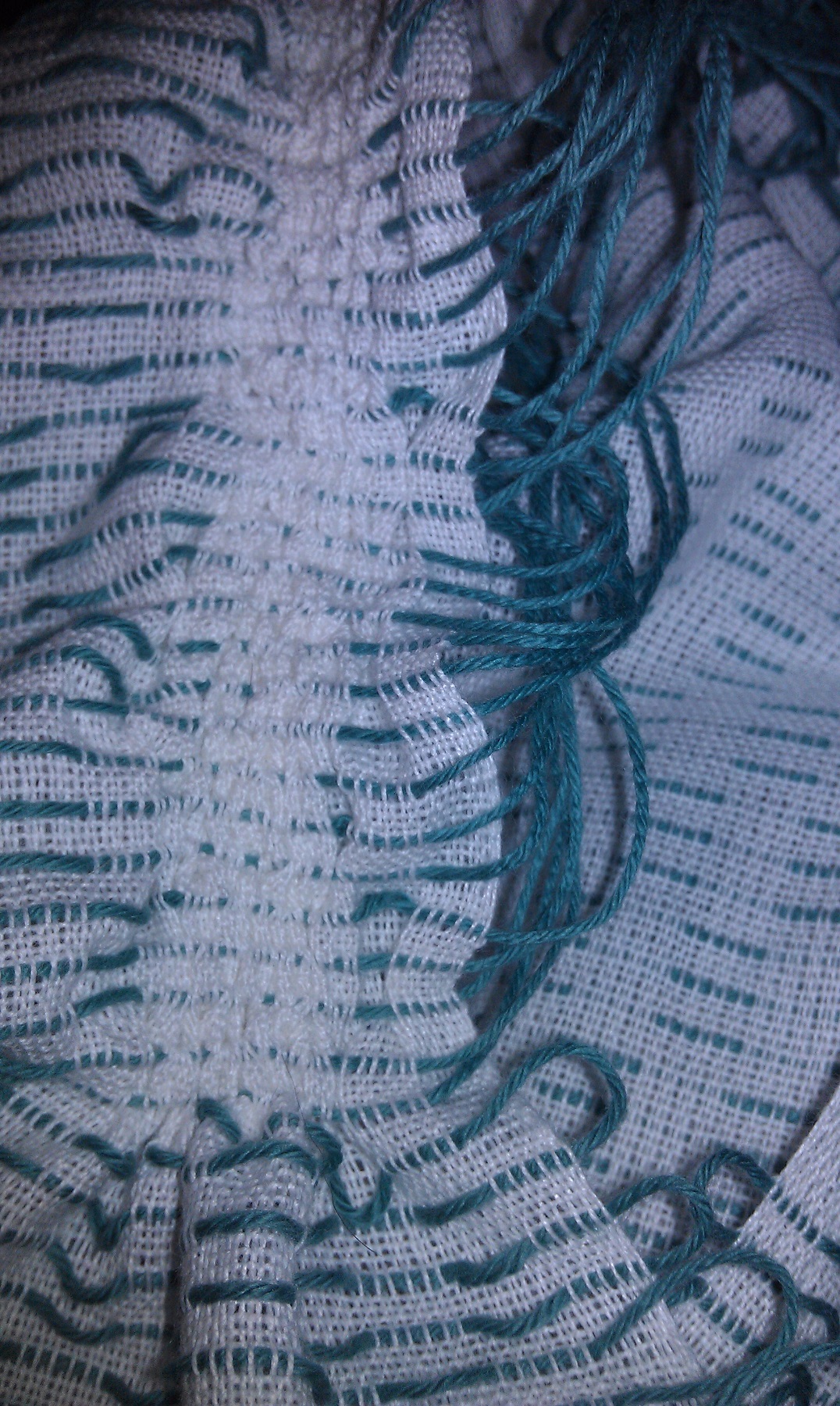
Beginning to gather and tie.

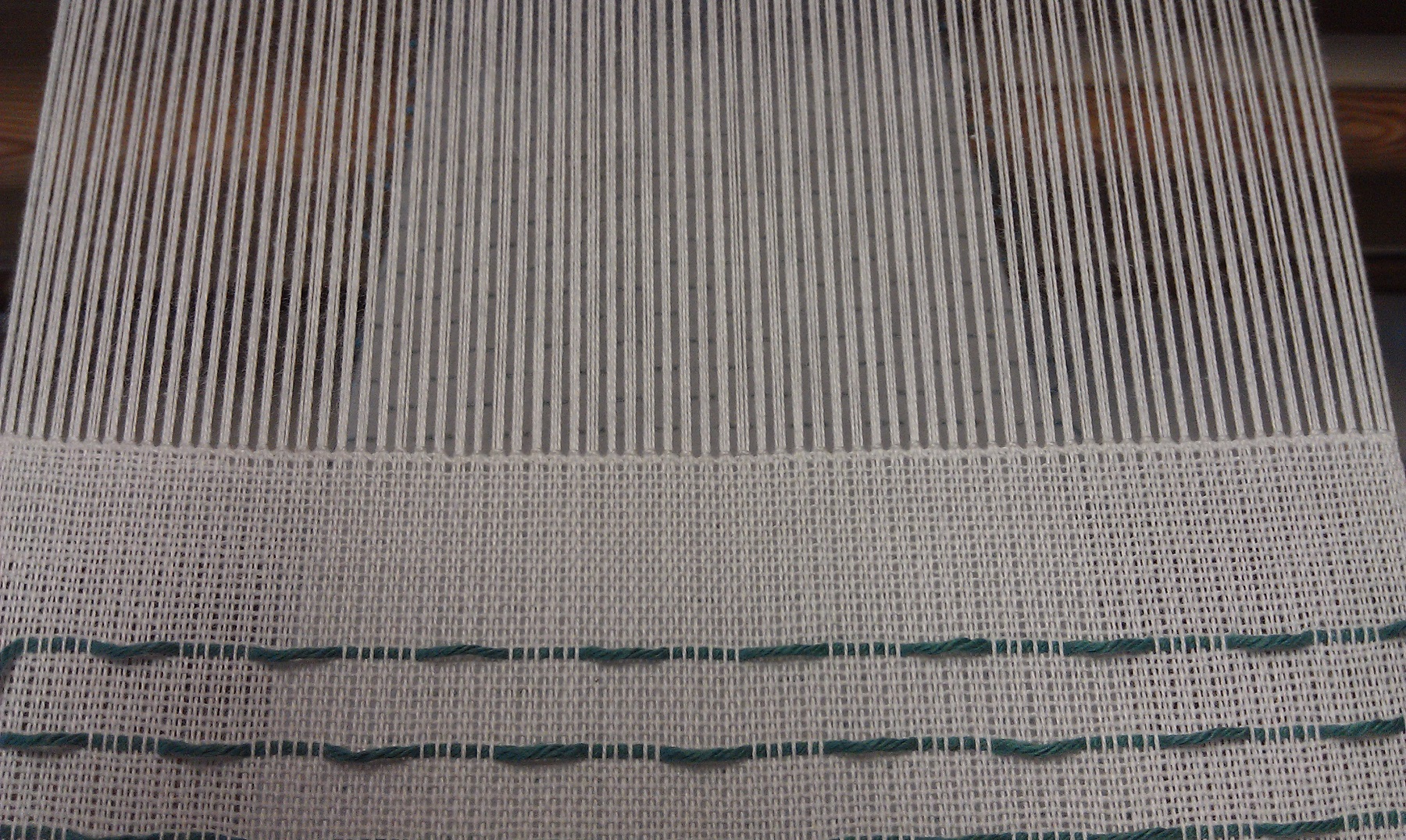
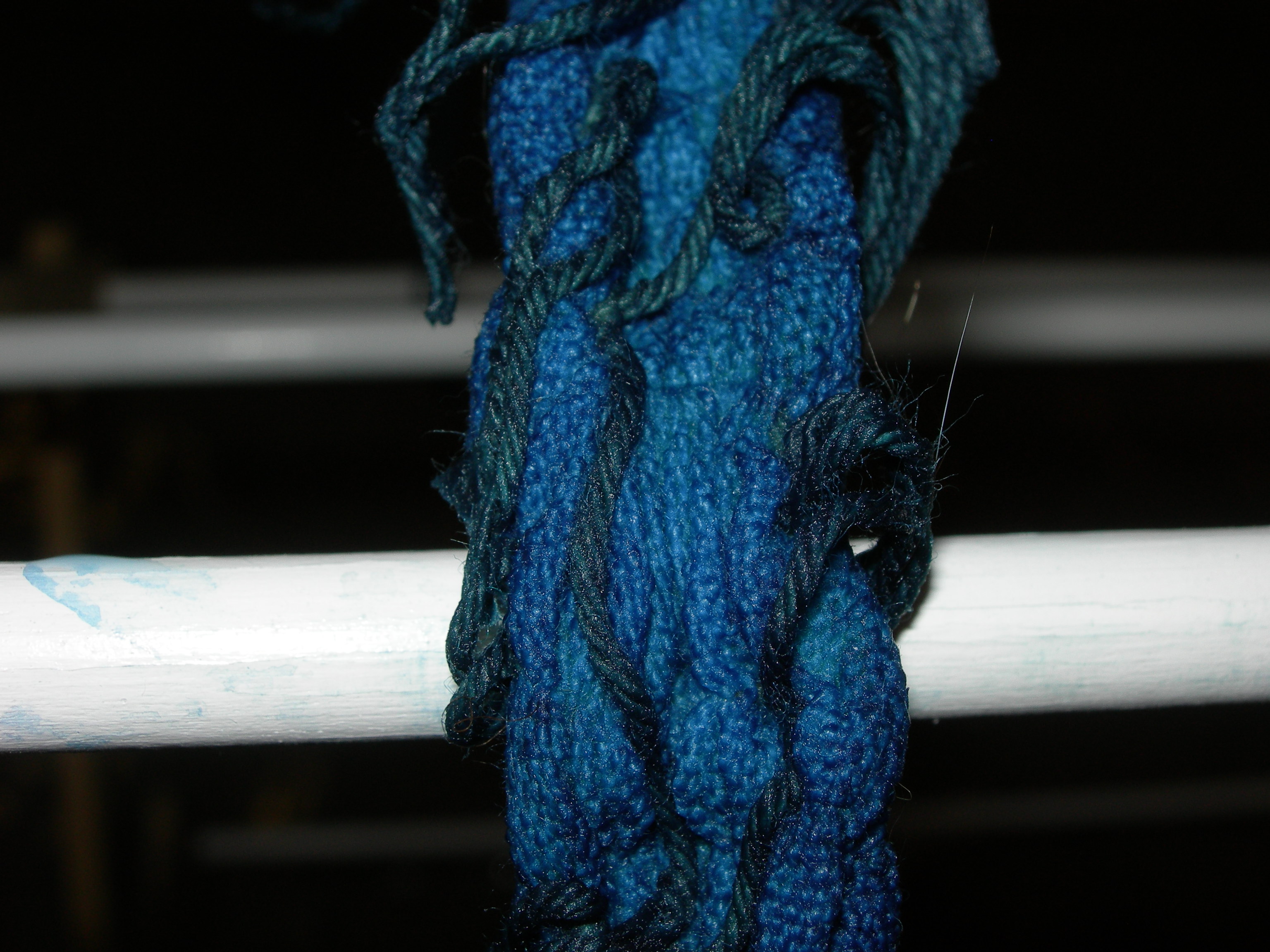
Above, the gathering and tying process has been started.  The teal pattern threads will be gathered and knotted as tightly as possible, then trimmed.

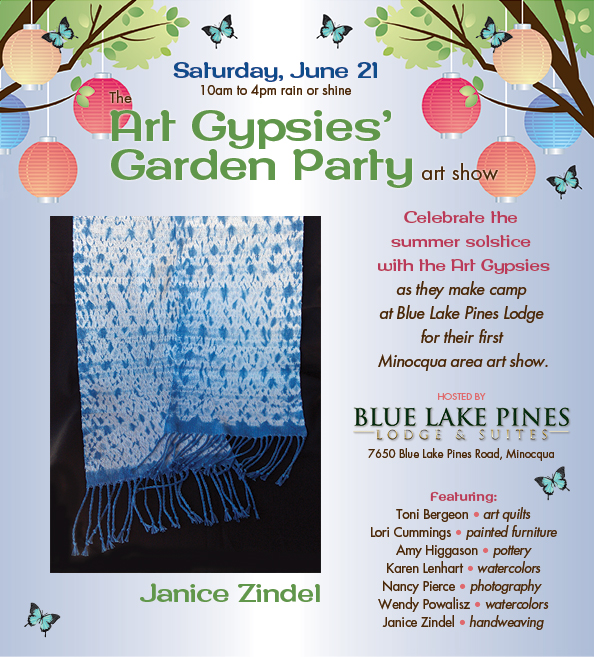
Art Gypsy postcard for June 2014.

The Art Gypsies, a small group of area artists, had their art fair just outside Minocqua this year, on June 21st.

Art Gypsies Wendy Powalitz and myself at the fair.

Wendy Powalitz graciously shared her tent space with me, where I had woven shibori scarves, “rag” runners, and a couple cottolin towels.  Despite a light rain, it was a beautiful day!

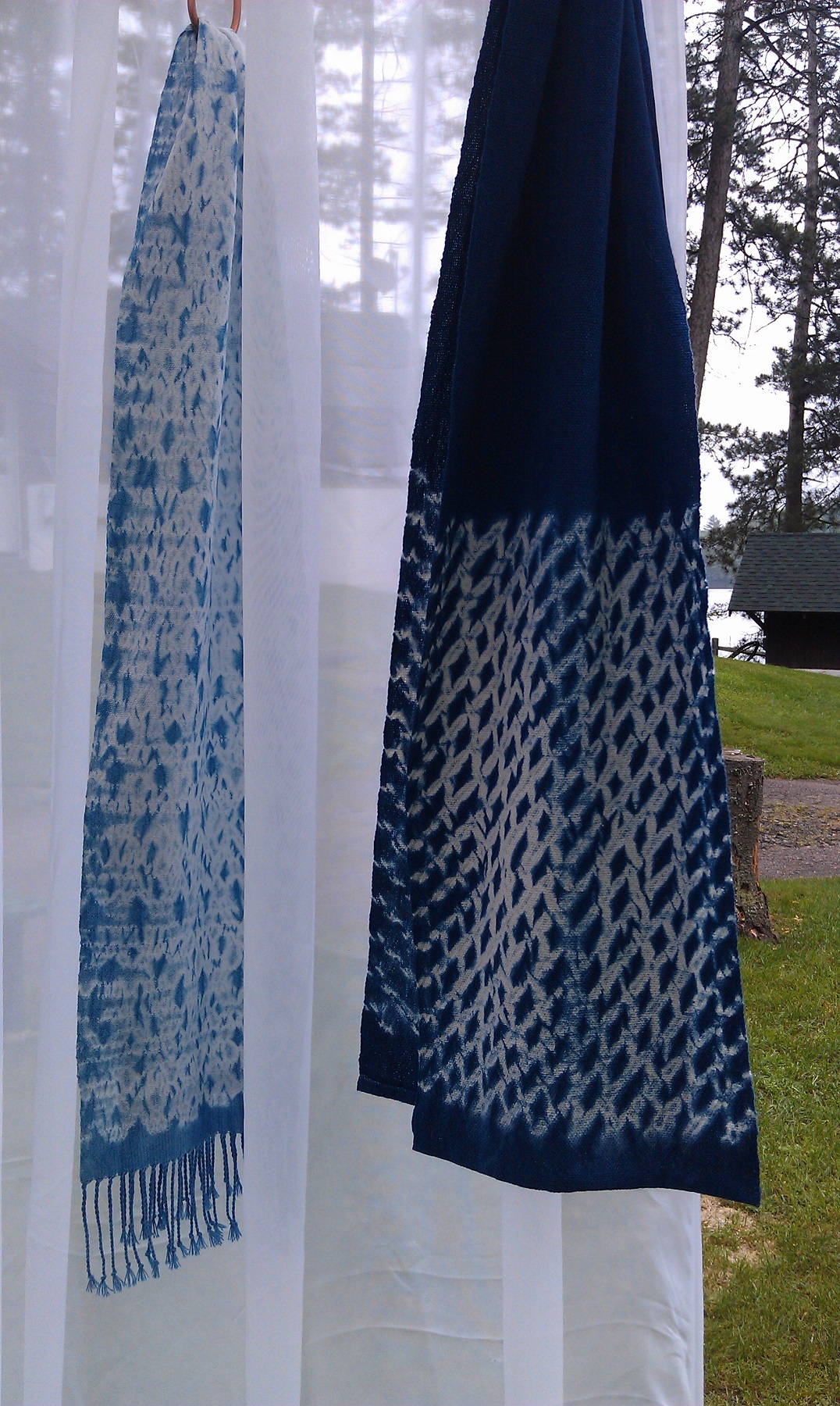
Woven shibori scarves.
More woven shibori scarves.
"Garden Party" was the theme that day.
“Garden Party” was the theme that day.

Then, it was time to prepare for the upcoming Northwoods Art Tour!

Tapestry Beginnings

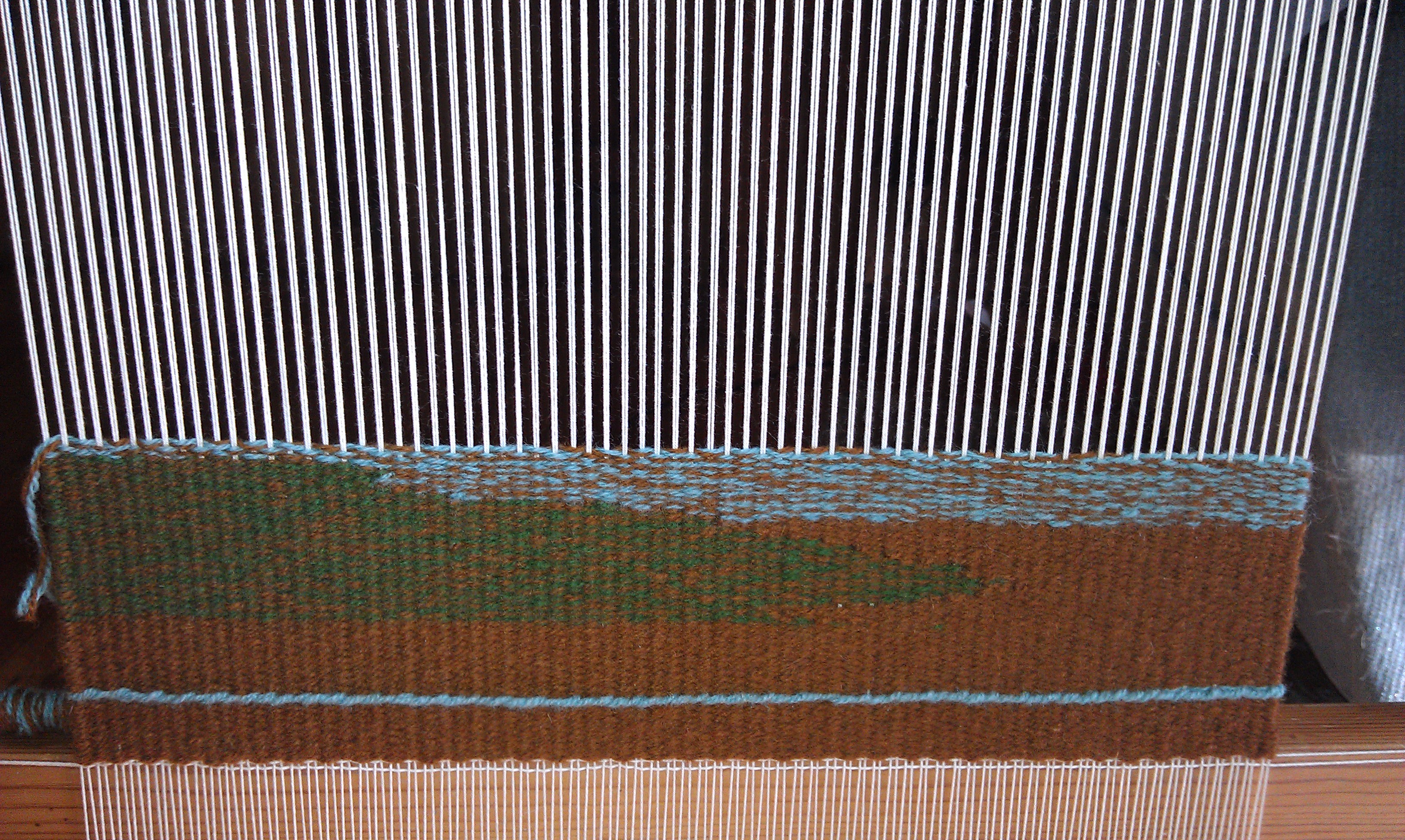
Tapestry beginnings.

For a long time I have wanted to try tapestry weaving.  I had joined the American Tapestry Alliance about 1.5 years ago, and had seen the two mentor programs they have.  In May I sent in an application for their Helping Hands program for beginning tapestry weavers, which is a six month commitment.  A couple weeks later I was matched with Pam Hutley, of Queensland, Australia.  We have started communicating and I’m looking forward to her advice, ideas, and critique.

An experiment.
An experiment.

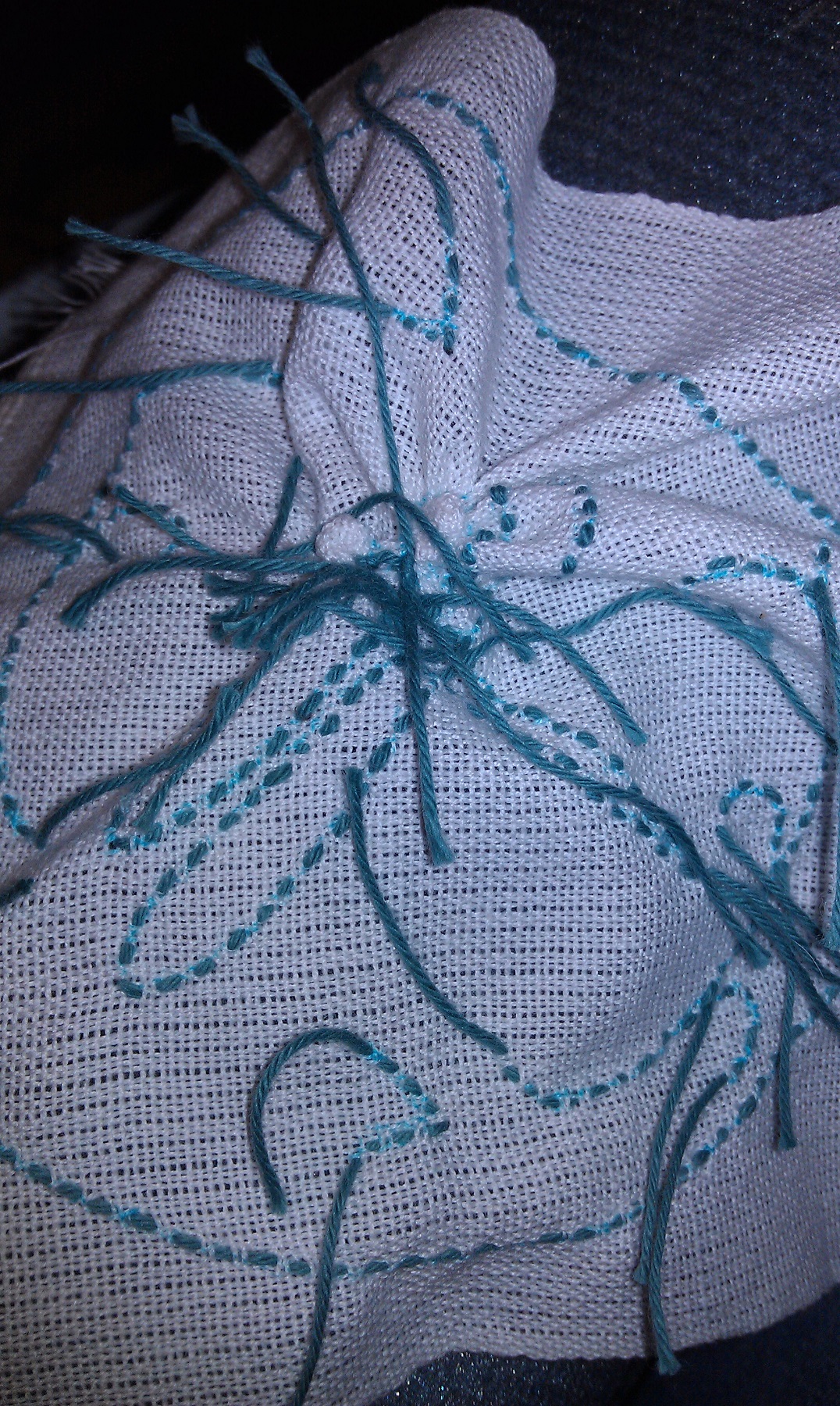
At the end of my last woven shibori warp, I woven a foot or so of plain weave, no pattern weft rows.  I had the idea of trying to stitch a design in by hand (above).

Experiment is gathered and tied.

After stitching a design, the thread sections were gathered and tied, and it will be going into an indigo vat this weekend along with two or three other samples.  Results in the next post.

Unwashed Lincoln fleece.

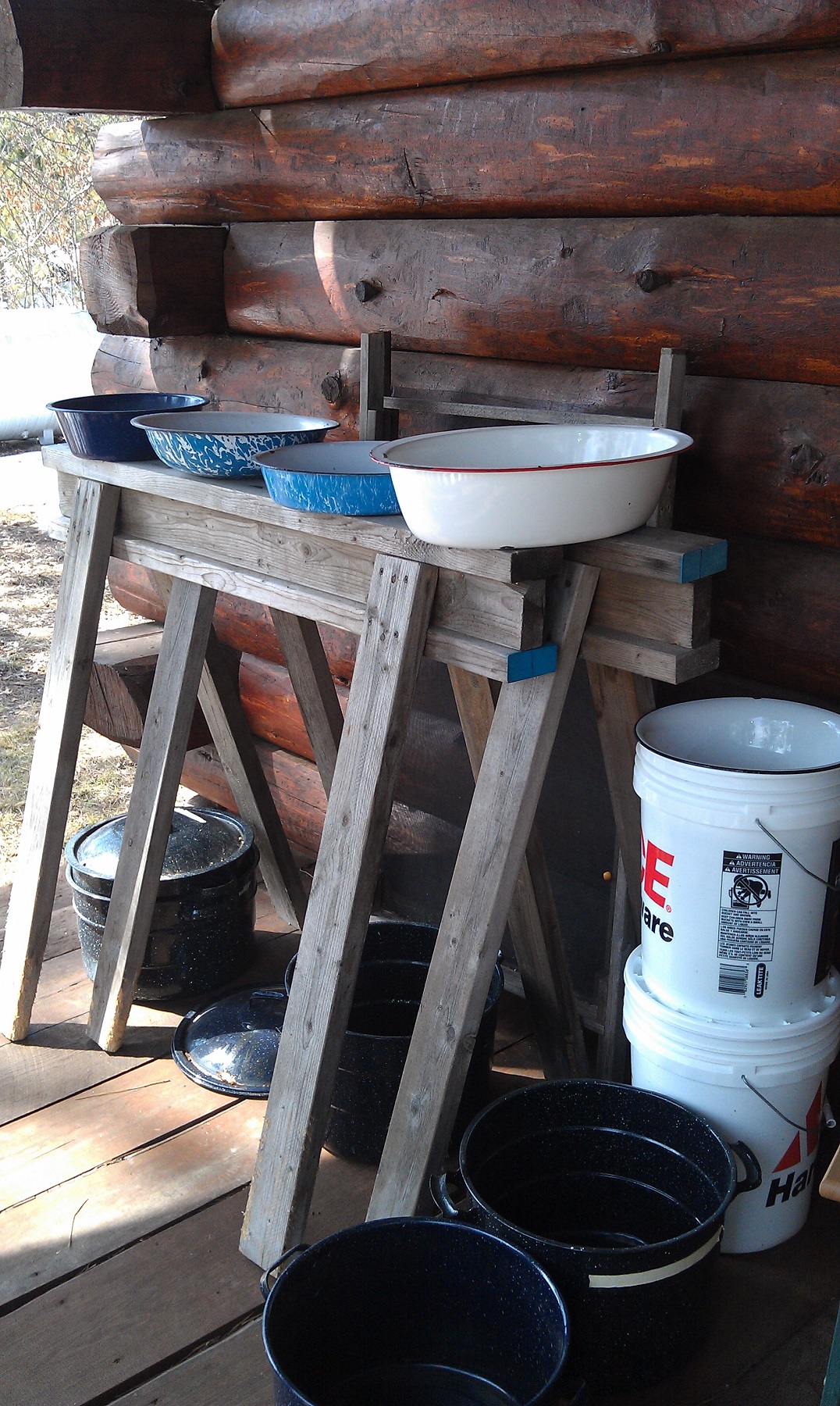
I have fleece waiting to be washed, a job I do in warmer months, outdoors.  In the last post there was my usual area on the lakeside porch waiting for this, but I had to remove it all because the porcupines keep coming up onto the porch and chewing on the legs on my wood sawhorses!
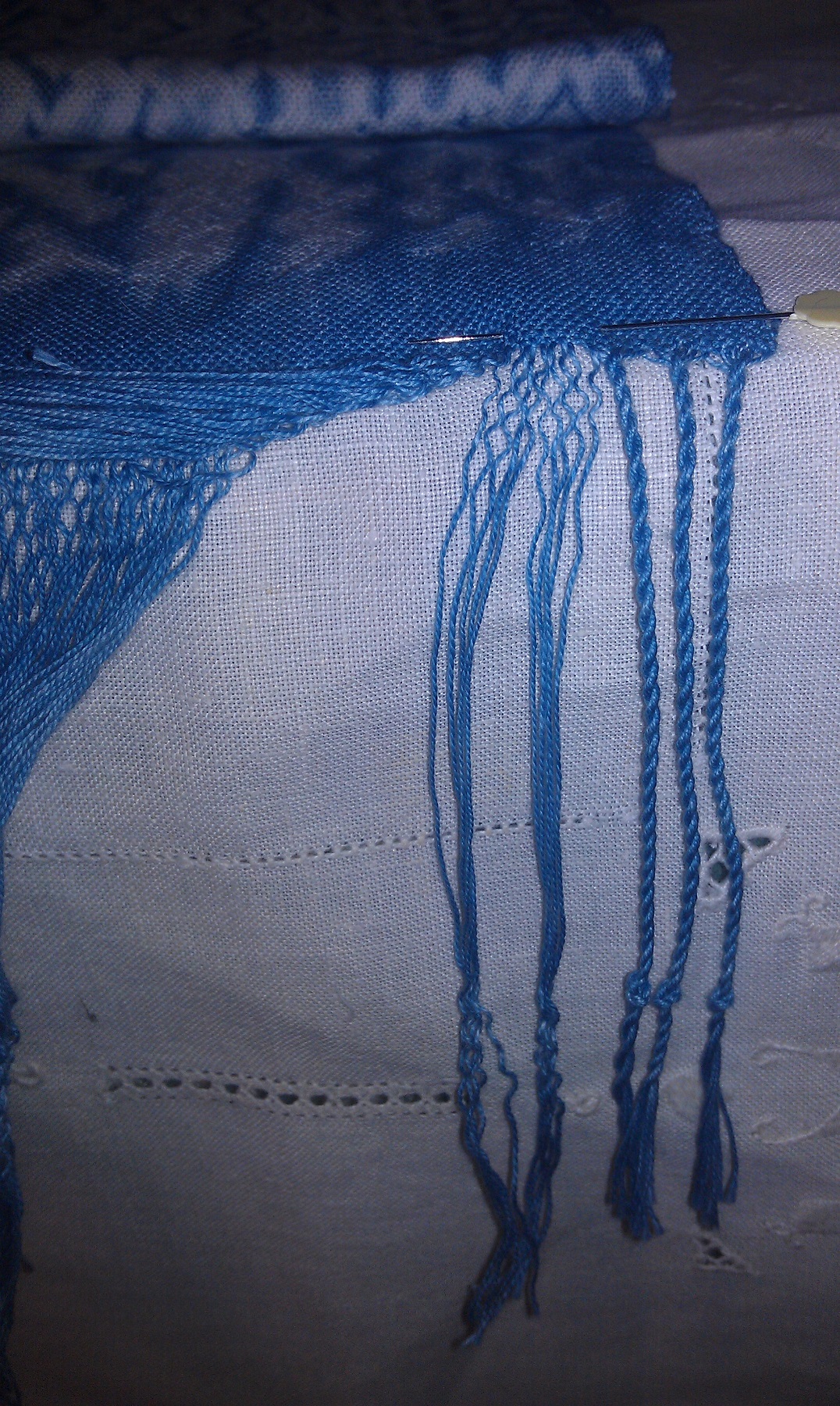
Lincoln fleece soaking.

I did set up the large canners/pots I use for washing fleece out on the lakeside porch, and did wash about half of a 6+ lb. fleece, which is now drying in the racks in the garage, away from hungry porcupines.

I’m looking forward to carding and spinning this fleece, as well as figuring out what I’ll be making with the yarn, whether knit or woven.

The Results Are In

I've Got the Blues.
I’ve Got the Blues.

Earlier in the month I had few more pieces ready for the indigo dyepots, and the results are in.  I finally took photos today and was quite pleased with this trio of scarves.  There is another still needing its fringe done.

Starting to hand-twist the fringe.

I had rinsed, washed and rinsed again, and pressed the pieces, and finally sat down to hand-twist the fringe.  Today, while looking for something in the studio, I found a gallon bag with another one or two samples and some silk thread I need to dye.  I’m about to finally wind a new warp so I can get back to weaving.  It’s been a busy month.

Transitions woven shibori scarf.

While finishing up the last warp I sat wondering if it would be possible to have a bit of control over the indigo dyed areas by which sheds were used and by the number of plain weave rows in-between.  My idea was to use treadles that had long floats at the beginning and end sections, and work in from both ends toward a lighter mid-section.  It worked, somewhat, but I’m not entirely happy with it as I was looking for a bit more gradual transition.  I’ll be trying this again.

"Memories of Norway, 1."
“Memories of Norway, 1.”
"Memories of Norway, 2."
“Memories of Norway, 2.”

Years ago I suddenly decided to try tapestry weaving, even though I had no knowledge of tapestry or how to even begin.  I made sketches, simplified to basic cartoons, and the results were the two tapestries above.  Woven on a Schacht table tapestry loom, using Navajo wool warp, and my handspun yarns for weft.  I was pleased with them at the time.

On Facebook, I follow several tapestry weavers.  Tapestry weaving is something I have wanted to try for many years, and the new large tapestry loom is glaring at me from the corner, asking why I’m not using it yet.  I’d been reading about several weavers who work on a tapestry diary throughout the year, and I thought that would be an interesting project and it would get me to sit down and weave on it each day.  I checked to see what warp they were using, sett, and try to get an idea of the weft to use.

Glimakra "Sara" upright tapestry loom.
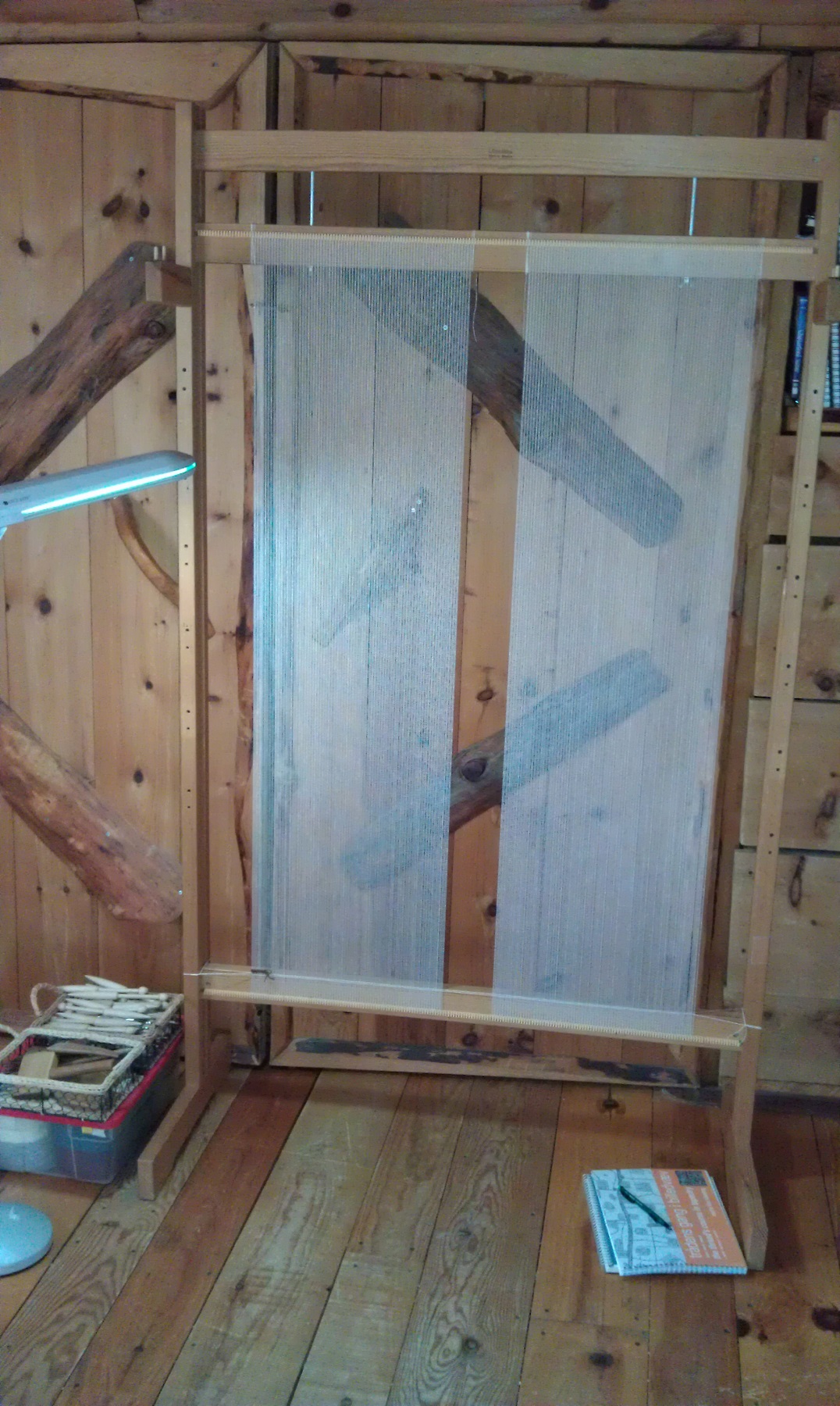
Glimakra “Sara” upright tapestry loom.’

Several years ago I purchased the “Sara” loom and I thought it would work for this daily tapestry diary project.  This loom can be warped at 6 epi or 10 epi, so I chose 10 epi.  I warped it with seine twine, and had 13 colors of Bockens 2 ply tapestry yarn.  It was warped in two sections, six months vertically on each half. I sat down to weave, and found the yarn, used double, was too much and would not cover the warp, but single yarn would.  The problem was, I wanted to be able to blend colors, use two colors at once, and short of un-plying the yarn, it would not work.  What to do?  Re-warp to 6 epi?  Order all new weft yarn?  Or, change the project?  I chose the latter.

Tapestry sampler at very beginning.

Plan B became weaving tapestry samplers, which meant more sketching, and now I must make a cartoon.  I have a number of tapestry books, and it is time to begin learning tapestry techniques, use of color, and so much more.  A new adventure!
Fleece washing area on the lakeside porch.

On one of the two nice days we had during the month of April, we went out to clean up and rearrange the lakeside porch.  I took that opportunity to set up an area for washing fleece.  Now, if the weather would just cooperate!

Always Magical

Woven shibori, with pattern threads in teal.

At last, I was nearing the end of this warp, threaded as an advancing twill on 8 shafts and using 8/4 teal rug warp for the pattern threads, and 16/2 Bockens cotton for the plain weave.  On these pieces, I was treadling in random order, and varying the number of plain weave rows.

The last of this warp, just removed from the loom.

The last of this warp consisted of two scarves, one sample, and a length that would be cut into four pieces and will be made into smaller items.

Soaking in water prior to indigo dyeing.

Later the next afternoon, I set up in the garage for indigo dyeing, setting the now gathered and tied pieces to soak in water while mixing up a new indigo vat.  I then measured indigo out into two more smaller buckets for “diluted” dyebaths for achieve a medium and bit lighter shades of indigo.

New indigo vat with "flower' forming on the surface.
New indigo vat with “flower’ forming on the surface.

The new indigo vat worked well, forming the “flower” on the surface, and after skimming it off (and setting it aside, to return to that vat when finished), the dyebath was the greenish color it needed to be.

A sample changing from greenish/blue to indigo blue when exposed to the air.

It is still magical, watching the wovens change from a green/blue to the beautiful shades of indigo blue.

Designs in one section of the long length of fabric.

After the wovens have been exposed to air and turned indigo, I give them a good rinse in a bucket of water, squeeze the water out, and hang them on a wood rack to begin drying.  When they are dripping, I move the rack into the house and turn a box fan on to encourage them to dry a bit faster.  Why?  Because I am a bit impatient to snip the knots along one selvedge, begin easing the gathers out, and pull the pattern threads out the other side so I can see the designs achieved from that particular threading and treadling.  Keep notes!

Detail of a shorter piece.

I then take and wash them, by hand, one-at-a-time, in Seventh Generation soap, and then rinse repeatedly until the water is clear. They are placed in a lingerie bag and run through a spin only cycle to remove excess water, and again, hung on a wood rack to dry. Before they are totally dry, I press them with a steam iron, hang to dry, then press again, and again, hang to dry.

Three of four pieces cut from the long length of fabric.
Two of four pieces cut from the long length of fabric, on the left, and a sample, on the right (dyed slightly darker).

I have two scarves left to finish, both needing twisted fringe.  Though it is early April, we have a snowstorm due tomorrow evening and overnight, a good time for that project.

Now, it’s time to decide on the length of the next warp, do my calculations, move the warping mill out, and get it made.  I’m thinking this time it will have the “pattern threads” run warp-wise.

Indigo dyer extraordinaire, Glennis Dolce (Shibori Girl) had shared a sample of warp-wise indigo dyed fabric with me, perhaps a year ago when I first started this learning adventure, and asked when I would warp up my loom for it.  I believe the time has come!  I will be using 16/2 cotton again, not as fine as the sample she sent me, which was likely machine woven, but should be another good learning warp, and if it turns out I must send a sample to Glennis.

No More Dallying!

Woven shibori scarf in progress.

It’s been a long and very cold winter, and I will spare you photos of the last blizzard.  It’s also been a period when I wasn’t feeling 100%, and more than anything wanted to hibernate, and often did.

Perhaps spring is on the way?  I want to weave, and am back working on a somewhat narrow warp for woven shibori scarves (above).  This scarf is being treadled randomly and the number of plain weave rows between each “pattern” row also varies. 16/2 Bockens cotton, sett 30 epi, and I’m using a neutral color of rug warp for the pattern rows which are removed after dyeing with indigo. Stay tuned to see the finished scarves!

Drawloom warp is threaded, sleyed and tied on, ready to weave.

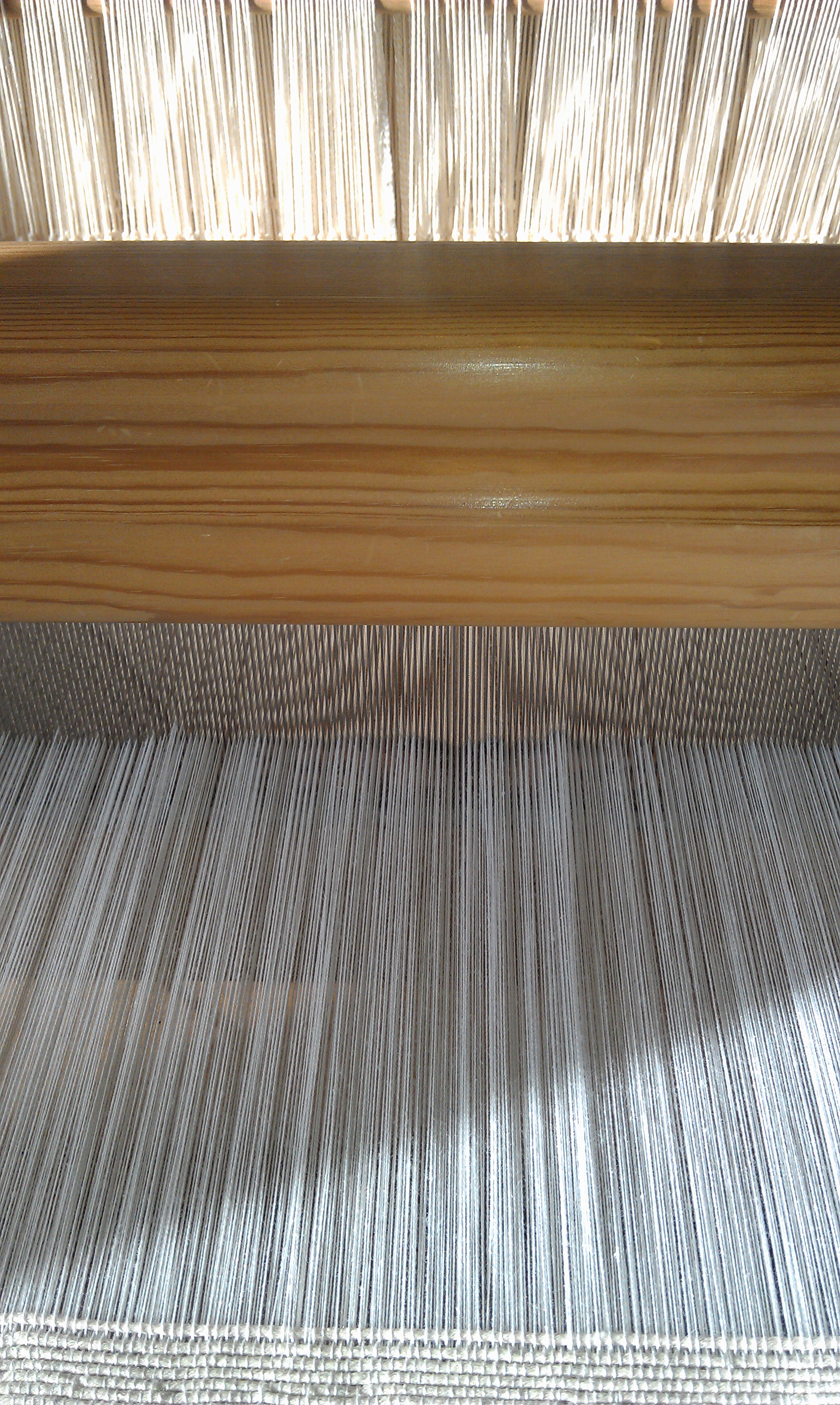
If I remember correctly this is a 20/2 cotton warp, sett 64 epi for 5 shaft (ground) satin.  The warp is spread and I’m ready to begin weaving.  Time to locate a chart I’d like to weave, to begin, then dig out designs I was working on, simplified from photos I took in China years ago.  I still need to transfer (and possibly enlarge a bit) to graph paper.

Glimakra "Sara" loom.
Glimakra “Sara” loom.

The Glimakra “Sara” upright tapestry loom is a simple frame-type loom, tall, on legs, adjustable weaving length, and has hard plastic “teeth” top and bottom to wrap yarn on.  This loom can be warped at 5 epi or 10 epi.  I may regret it, but I warped it at 10 epi with bleached 12/6 seine twine after finding the linen I was going to use was a bit too wide/coarse for that sett.  It is warped in two sections for a tapestry daily calendar.  I had decided to try this in February, then promptly came down with a head cold.  Now, I can either make up the weaving, or start March 1st.

The idea of a tapestry diary or daily calendar is to weave a small bit each day which is appealing and doesn’t feel overwhelming.  I’ve been debating with myself over how to approach this weaving,… vertical or horizontal?  A particular shape (square, rectangle, trapezoid)?  Freeform?  Color approach?  I do know this will also be a good way to learn and experiment with tapestry techniques, and color.  It’s time to sit down at the loom and take the first step, then I’ll be asking myself what took so long.

Behind the “Sara” loom in the photo above is the new-to-me “Regina” tapestry loom.  Part of the studio was rearranged to make a nice home for it, lights will be installed shortly, and I’m waiting for a new 8 dent stainless steel reed to arrive, again, from Gowdey Reed Company in Rhode Island.

The pace of life is about to pick up.  My younger daughter’s wedding is in two weeks.  We’re hoping the weather will begin to warm up a bit in early April so we can begin refinishing floors, then treating the log walls.  Our first seed order arrived and very soon we’ll be setting up and “fencing” a table in the basement where we can start seeds (and keep the cats out!).  After the snow has melted and frost is out of the ground, we’ll set up raised beds, put up fencing, and plant vegetable and flower gardens.  We’re planning to add bees next year.

And while all those projects are going on, the weaving must continue, and we’re finally going to add the opphamta attachment to my Standard loom, something I’ve been waiting years for.

In addition to the Northwoods Art Tour, and one or two open studio days of our own, I’ll again participate in a show with the Art Gypsies.  A busy and exciting year coming up!

New Weaving Adventures Ahead!

Things have been quiet in the studio the past month or so, between the winter blahs, and waiting for a reed to arrive. One evening I was thinking the seine twine heddles on the drawloom were a bit too heavy for the dense sett, and the next morning I had a note from another weaver saying she had experienced the same thing and perhaps I needed to make them from something a bit finer.  I would need to order a bit finer seine twine.

While on the computer looking up seine twine sizes, I decided to look at the GlimakraUSA used loom page. Not long after I first learned to weave (1981) I’d seen a Glimakra catalog and decided someday I would have a Glimakra Regina (vertical) tapestry/rug loom. A few years later they stopped production of that loom. I was so disappointed but thought perhaps someday I would find one.

I’ve been watching used loom lists for years, but that loom seems to be somewhat rare here and they were always far away and would cost hundreds more for shipping, so I kept waiting and hoping.

The day I looked again, there were a couple for sale, one in AZ, another further away. Going down the list there was another,… an HOUR away from my home, and looking at the email address realized it was Carol, one of our guild members.  Picking up the phone, I called her right away, asked questions, and agreed to buy it.

Glimakra Regina loaded into my car.

A few days ago I drove over and we were able to load all the pieces up into my car.

Box with ratchets, treadles and wedges.

On the front seat was the box holding the treadles, ratchets, wedges, and instructions for both loom assembly and warping.  The loom is 60″ wide and has 3 sets of treadles.

The loom had a few extra parts, as Carol had had a woodworker make extra shafts and treadles so the loom could be used as a 4 shaft loom.  They will be useful in the future, but to start I’ll be using the loom’s original two shafts.

Glimakra Regina (vertical) tapestry/rug loom, now assembled in the studio.

On Saturday, with Char’s help, the loom was assembled. My preference for reeds is stainless steel reeds, the reed that came with the loom wasn’t, so on Sunday, I was back online ordering a new 8 dent 60″ 8 stainless steel reed from Gowdey Reed Company in Rhode Island.  I’ve ordered from them before and their reeds are well-made and strong.

Needless to say, I’m excited to finally have this loom and very excited about the possibilities!  And Carol is VERY happy the loom was going to my home studio.

Now, I need to decide between starting with a tapestry sampler or a Scandinavian style Rana, and get warp and weft ordered.  Since I am starting a tapestry diary on the Glimakra “Sara” loom, and have a tabletop Schacht in reserve for starting to learn tapestry techniques, the thought of weaving a Rana is highly likely. Examples of Ranas may be found in “43 vavar av En enda varp” by Leena Svensson; “En annan bild av Lappland” by Doris Wiklund; and “Old Swedish Weavings from North to South” also by Doris Wiklund.

Carol and I are also going to partner up and be our own weaving study group as our area guild members prefer social meetings only. We’re exchanging emails detailing our weaving interests to find topics we would both want to learn and spend time on. More to look forward to!

Now, down to work in the studio, so I can get back to sharing photos of weaving!

Very Close to a Working Drawloom

I am very happy with the progress made this afternoon on the drawloom.  I looked closely again at photos of a drawloom, identical to my loom, taken about 29 years ago.  The counterweights looked to now be at the proper height, but the beater seemed low so that was raised, then came more adjusting of shafts, lamms, and treadles.

At long last we seemed to have quite good sheds, with just a few threads out of place, but I believe they are being caused by two broken warp ends tangling with neighboring threads, and they will be fixed Thursday.

You couldn’t really see them in the photo yesterday, but there were some loose, “baggy” heddles on the first four shafts and I was wishing I’d replaced them while threading.  Then I decided three shafts not being used would be removed right then, so that was taken care of.

I bought this drawloom used, about 29 years ago, and it came with “string heddles,” made from what feels like seine twine, but slightly finer than the 12/6 sold today.  Four years ago, after calculating the heddles I would need, I found there were nowhere near enough, so I went on a two or three evening binge of making the needed long-eye heddles.  It turns out I had left some of the old ones on the loom in case they were needed.

Homemade long-eye heddle jig (made on short notice, by Char).  150 made this evening.
Homemade long-eye heddle jig (made on short notice, by Char). 150 made this evening.

They were needed, but after threading, sleying, and lashing the warp on, I did not like the baggy heddles constantly moving outward, so the warp was un-lashed, and the threads in the baggy heddles were un-sleyed and un-heddled.  Then I asked Char, on rather short notice, if she could quickly make a heddle jig using one of my long-eye heddles for a pattern.  She did, and another 150 long-eye heddles (always keep a tube of 12/6 seine twine in your stash!) were made.  Late this evening, the tremaining original heddles were removed from shafts 1-4 and the new ones placed on the shafts.

In the morning, I’ll re-thread the 150 or so threads, re-sley, lash the warp back on, check the sheds again, and hopefully, at long last, finally be able to start weaving!  I think I’m fine, but a couple members of my family said they can see the excitement! Perseverance is a very good thing!  And having Char to help puzzle all this out and help make adjustments has been a blessing!  Thank you, Char!

After we were done this evening, I was showing Char examples of double-harness weaving including an example of weaving I’d done on this drawloom 29 years ago, a piece woven on a loom with an opphamta attachment 30 years ago, as well as my samples from the Basic Drawloom class at VavStuga (from Nov. 2012).  She was surprised and a bit impressed with what can be done on these looms. And now I’m looking forward to years of double harness weaving!

There will be a break while I weave and Char continues with her woodworking projects, and then we’ll see about getting the opphamta attachment added to the standard loom.  I can hardly wait!