All posts by janicezindel

DIY Pattern Heddles for Drawloom

Now that there are an another 1,000 long-eye heddles on the drawloom ground shafts, it’s time to get back to making more pattern heddles.

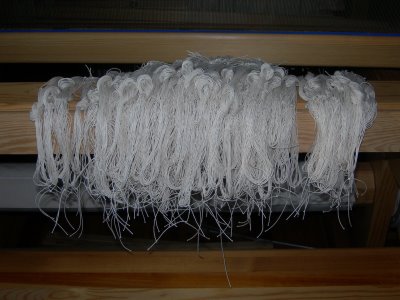
Months ago I ordered 400 or so plastic maillons from Sara von Tresckow, The Woolgatherers, in Fond du Lac, WI. Each maillon has six small holes and a slightly larger hole on each end. The smaller holes are for fine warp threads, the larger holes are for assembling the pattern heddle. If you are working with 8 thread blocks, you can also use the larger holes on each end for warp threads.

Around 14 years ago I made some of these heddles using a fine, coated thread and as there is still plenty on the spool, it is what I am using again. There is no label in or on the tube as to what this thread is made of. It is not easily broken.

As I wove on this loom 13 years ago, so know these pattern heddles will work. I am using an old one as a guide, and cut the top and bottom threads (24″ each) tieing one thread to each end of a maillon. On the bottom, I add one lingo to each pattern heddle. The top of each pattern heddle is tied and hangs on the wood pattern heddle rods.

I have not yet been able to recall the adjustable knot Ken showed me, so am just tieing the top ends for now. A neighbor loaned me an older book of knots and I’m hoping to figure this out.

If I were to warp the drawloom at 60 epi x 36″ width = 2,160 threads (I’ll need to make a couple hundred more long-eye heddles, more if I go wider) divided by 6 threads per maillon = 360 pattern heddles needed. I’m using these figures as an example, and figuring this out as I go along. Now, I need to get busy and make about 250 more pattern heddles.

Then I’ll move on to replacing the drawcord warp. I have been researching and asking other drawloom weavers for advice/suggestions on this, and must go back and review their recommendations, make a decision, and place an order very soon. Unfortunately, the coated linen of the former drawcord warp is no longer available.
From Towel to Sample


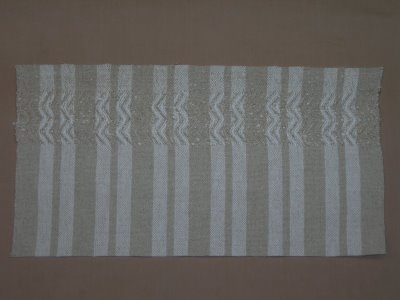
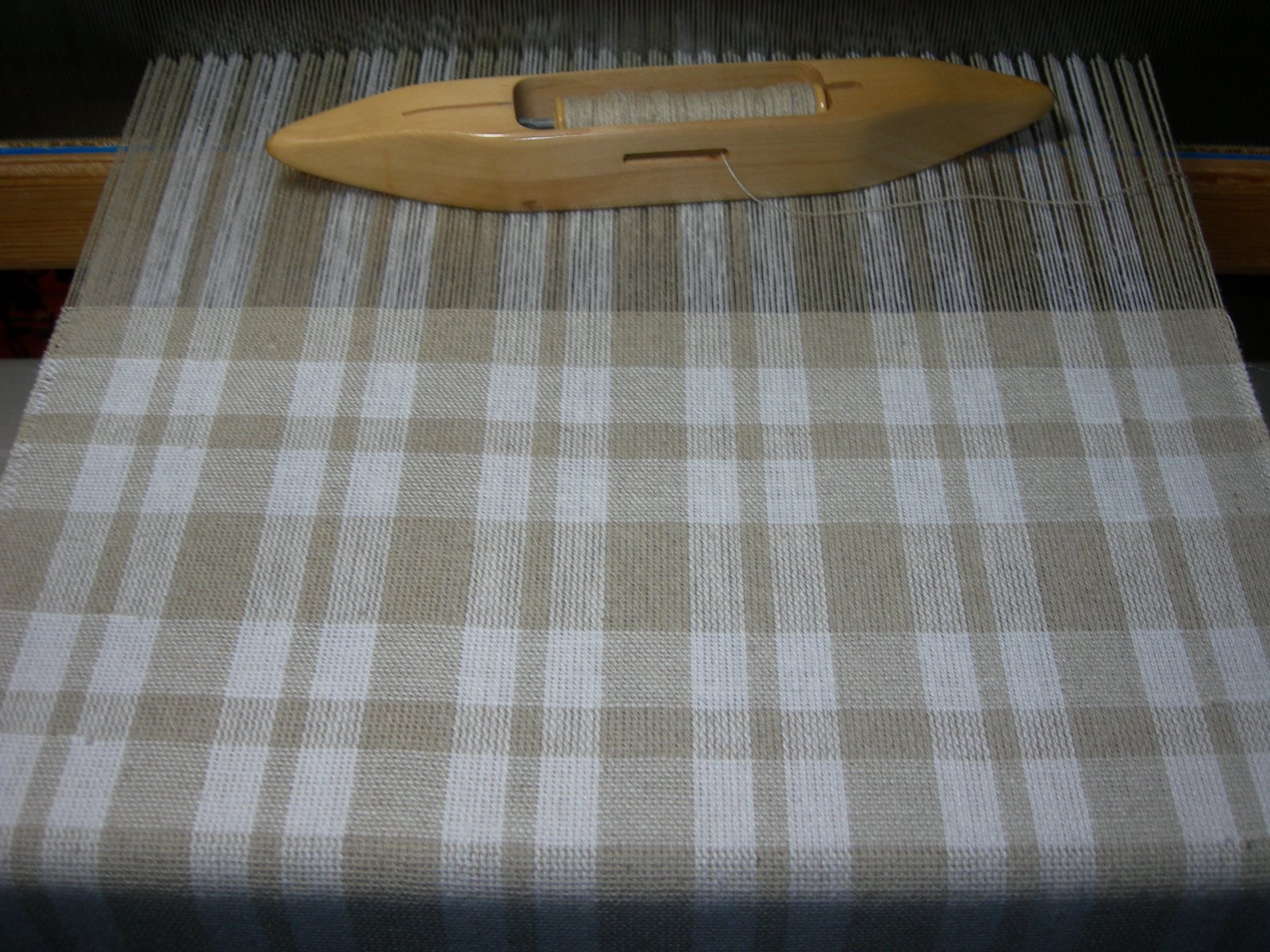
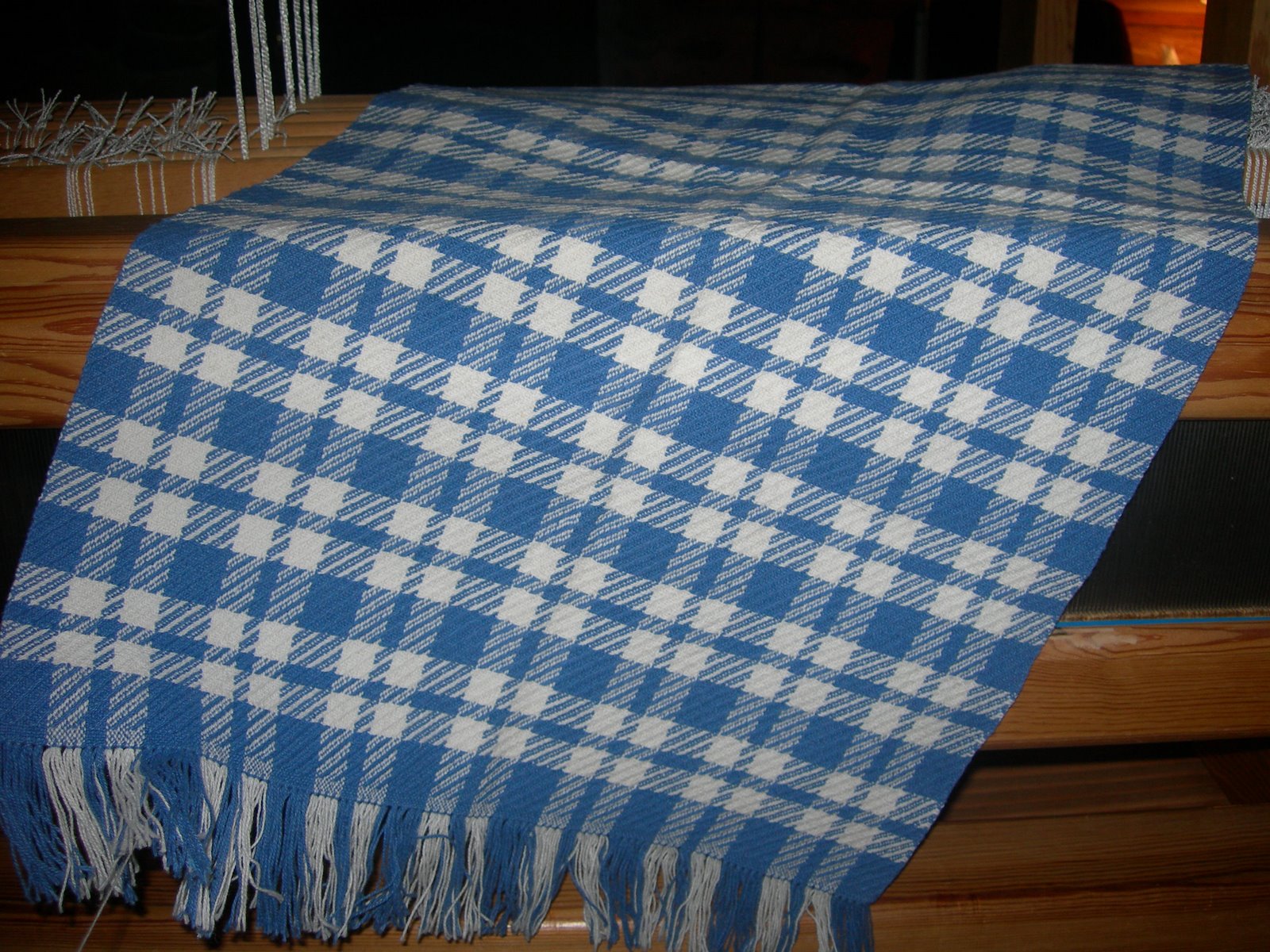
Years ago, I wove a blue and white “plaid” twill towel, with 1/2″ or so of plain weave on each end, and hemstitched on the loom (above). I didn’t recall any issue between the plain weave hems and the twill body of the towel. Both warp and weft were Swedish cottolin.

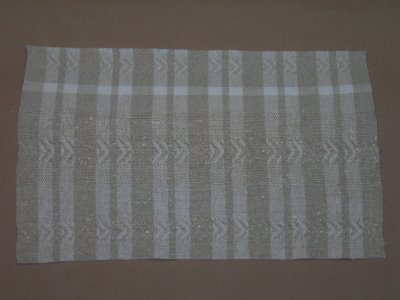
I recently read somewhere about tabby and twill together causing twill to ripple. When I began the first twill towel on this striped unbleached/bleached cottolin warp, that is exactly what happened. Ripples, probably more noticeable because of using different wefts for hem and body of the towel, and using one of them doubled. I had begun with a cottolin plain weave hem (to turn up and sew later), then changed weft to the linen/cotton slub, using a shuttle that holds two bobbins. I thought a bit coarser, rustic look would give variety to this series of towels, but felt the double weft would not make a nice, sewn hem.

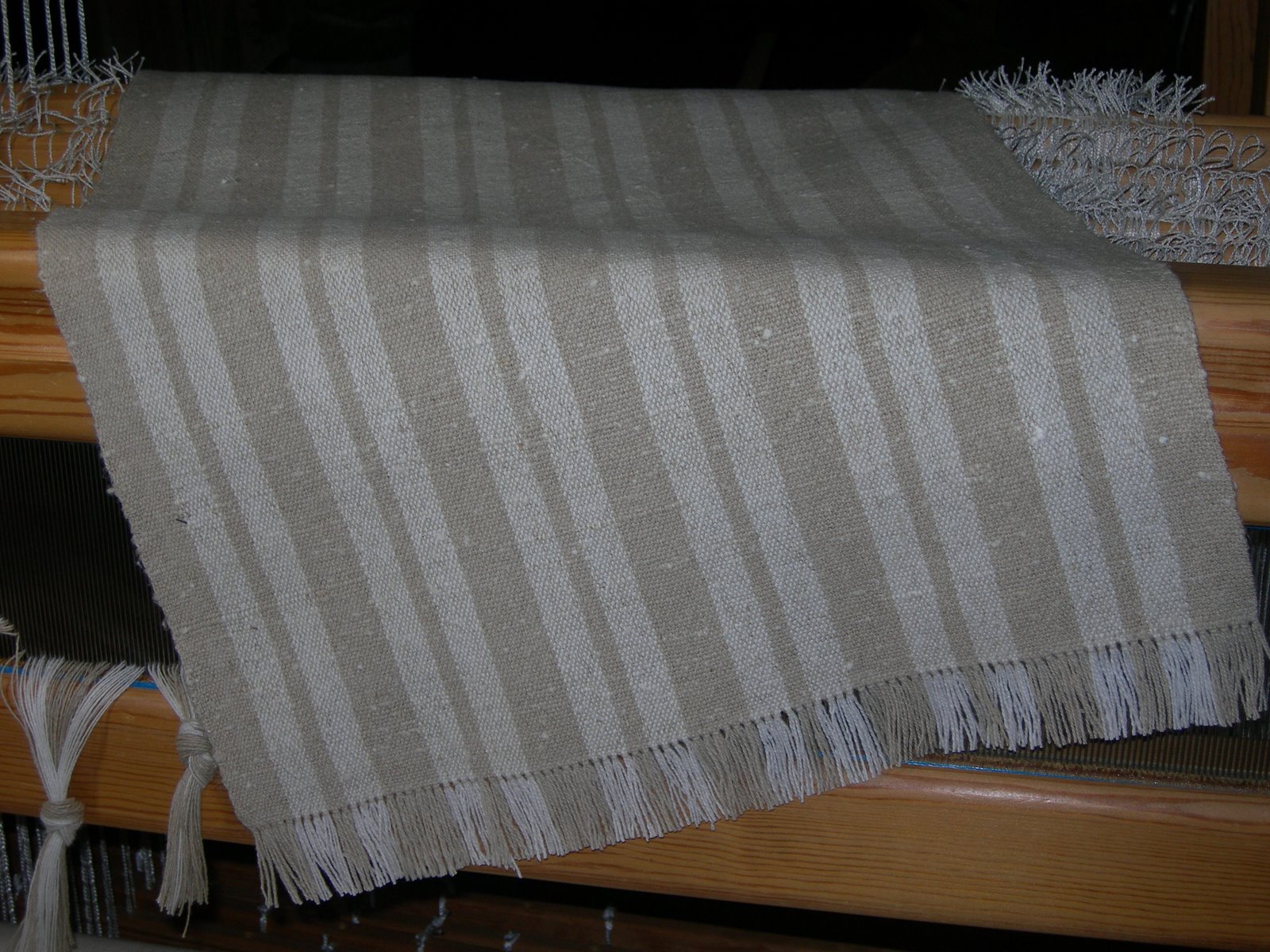
Not pleased with what was happening, I decided this morning the beginning of this first twill towel was now a sample (above), as I needed to discover what was going to work best for hem and twill. The cottolin hem was woven so I wove a couple inches of twill, then wove another hem using a single strand of the linen/cotton slub, woven in some string and removed it from the loom.


Since I still had the sample (above) from the very beginning of the warp, and both samples had ripples, both were tossed into the washer (regular cycle, warm water) and drier (normal cycle), removing them while still slightly damp. When they came out, the ripples were more pronounced. When pressed with an iron, the ripples pressed out. Selvedges were still a bit of an issue where plain weave and twill changed. Edges were rotary cut, and photos taken.

Tomorrow morning, I will begin again, using a single strand of the linen/cotton slub for both hem and twill, which should alleviate some of the problem. I expect if I weave 1/2″ or so hem and hemstitch on the loom, there would be little or no ripple effect. We’ll see, on this towel, or the next.

Simple, Functional Towels

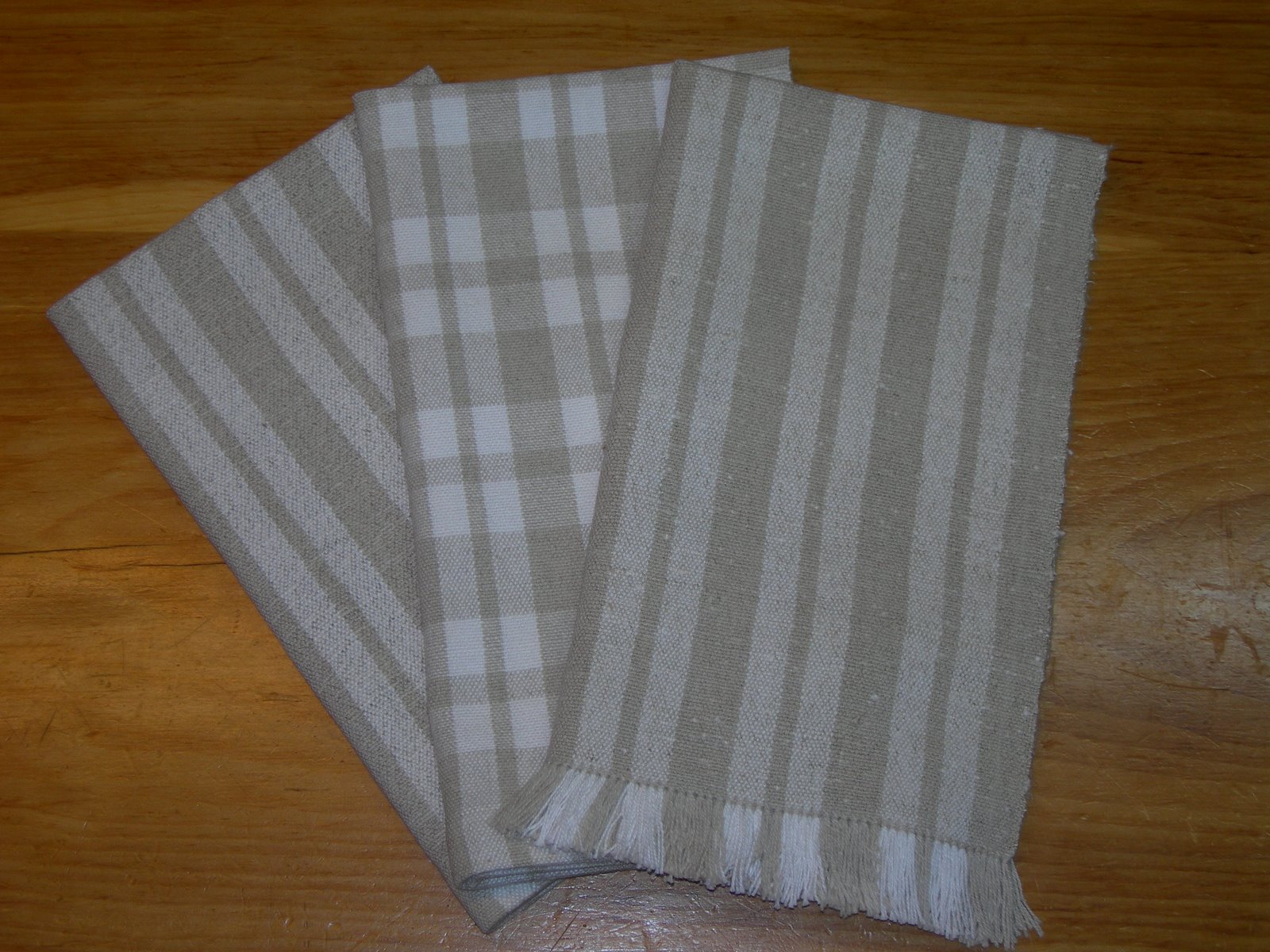
I’ve been looking forward to seeing the first three towels, together, and finished, and was able to do that tonight. The towels on the left and right each had a different weft, and though they look very much alike, if you look closely there is a subtle difference.

In a few minutes, the warp will be lashed back onto the rod and the loom will be ready for me to begin weaving more towels tomorrow. Again, there will be different wefts used, some “solid,” some overall plaid, some with plaid borders, all in twill. After those, I plan to play around with with treadling and see what happens with the remaining warp.

I’ve been cranking socks again, sold a pair today, mailed a pair off to NY state, and have three or four more orders to take care of. Now, I’m looking for a balance in time between the weaving I want to do, and the socks needing to be cranked, and still allow some time for spinning and felting. I have a lot to accomplish before spring and warmer weather, when I will also need to work on the house.


The photo above is my home and weaving studio in the Northwoods of WI.

Weaving Hint ~ Keeping Heddles on the Shafts


Have you ever had heddles (Texsolv or string) slide off the ends of your lower shaft bars? I have. About 17 years ago, I learned an easy, inexpensive fix for this from Ken Colwell…

Take a length of strong thread (seine twine, cotton), measure twice the length of the lower shaft bar plus a few inches extra. Thread it through the small hole at one end of the shaft bar (front to back), take it along the length, in back, thread through the small hole at the other end (back to front), and tie the ends together at front center. Make sure the string, both in front and back of the lower shaft bar is OUTSIDE the heddles. This will keep the bottom of the heddles from sliding off. If you place the string inside the heddles, they will slide off. This works for both Texsolv and string heddles.

I usually use this method on my looms. Not long ago I moved heddles on my countermarche, and neglected to put these strings on my CM shafts. Yes, a few heddles went sliding off the lower shaft bar. I was finishing weaving the hem of a towel and didn’t notice right away that the first shaft was hanging up on the right side. After removing the temple, I found a few floats at the right side of the hem which were easily repaired, but could have been avoided. These strings will be back on every shaft on the CM loom before I begin weaving again on Wednesday.

Tuesday? Socks, all day!

Adding Long-Eye Heddles to the Drawloom

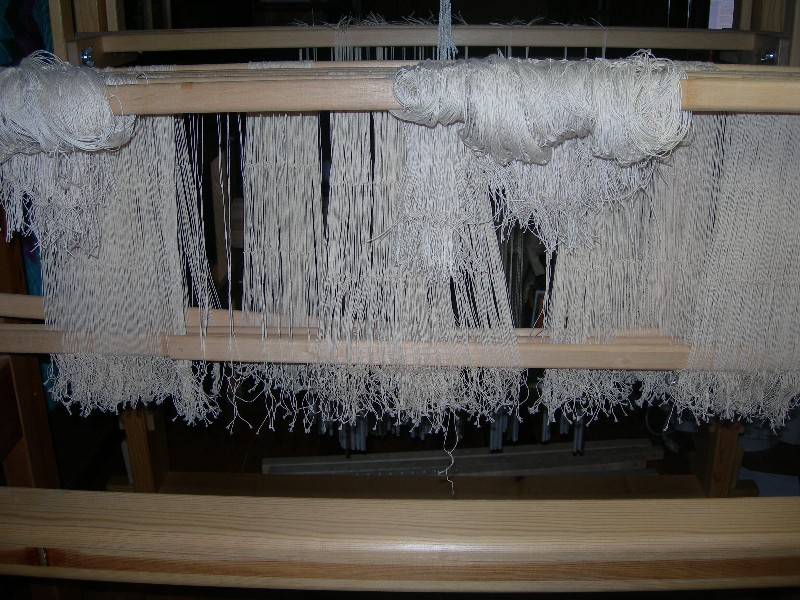
Finally, a sunny afternoon and with extra hands at home, I was able to move 500 old string long-eye heddles to the back five shafts, on the drawloom, and add 800 of the 1,000 new string long-eye heddles (that I just finished making a few days ago) to the front four shafts.

All that is involved in adding heddles is removing the anchor pins in the jacks, one at a time, dropping the cords down through, removing and/or adding heddles to the shaft, then threading the cord back up through the holes in the jacks. A bobby-pin works great for threading the cord back up through the holes in the jacks, then put the anchor pins back in, making sure the shafts are level. (Note, this is for the older style Glimakra single unit drawloom, from 1984 or so.)

There is one shaft and accompanying jacks not on the loom. I am sure the shaft bars are upstairs, but I’m not sure about the jacks, so I will check for them tomorrow. Once they are on the loom I’ll be able to add the last 200 long-eye heddles.

Right now, I am making sure the heddles are not twisted, then adding the lower shaft bars back in. This is not a difficult task, just a bit time-consuming. I would rather do it properly now rather than encounter difficulties when threading or nearly ready to weave.

When the lower shaft bars are all in and twisted heddles are straightened out, I will add a long string to each lower shaft bar which will keep the bottom half of the heddles from slipping off the lower heddle bars. Pic(s) on that will be posted in a day or two.

The plaid towel is off the loom and upstairs along with another towel, next to my sewing machine. After the hems are sewn, a photo will be posted here. Right now, back to the heddles.

Simple Towels

Today was again spent at my loom weaving another towel, this time “plaid,” following the simple stripe pattern in the warp. I’m enjoying weaving each one up differently and looking forward to group photos of the towels to show the variety. Although they are plain weave or twill, a nice variety of looks can be achieved.

Six more tubes of natural/unbleached cottolin arrived today so those, along with the several tubes of bleached I already have, will keep me in weft for awhile yet. Also in the package were two more tubes of seine twine so I can go back to making heddles whenever I am ready.

Linen/Cotton Towel & Drawloom Heddles


The first towel off this current warp is finished. I had hemstitched this one, washed it in warm water (in a front-loading washer), dried it on Normal, then checked dimensions. Off the loom, prior to finishing, the towel measured 30″ in length by 16″ in width. After finishing, the measurements were 22.75″ by 14.5″ losing 7.25″ (24%) by 1.25″ (8%). I was especially amazed by the shrinkage in length as I didn’t recall previously woven towels or runners woven with cottolin losing that many inches. (These measurements do not include fringe.)

I also noticed there seemed to be some tracking which I was not expecting. I’ve not had tracking occur occur before with cottolin but this weft is a single linen/cotton slub/flake type yarn. After sorting out the tangled fringe, the towel was spritzed with water, ironed with steam, then ironed again without steam. When fairly dry, I rotary cut the fringe leaving it 1.25″ in length.

I am quite pleased with this first towel and looking forward to weaving up more, varying the wefts and textures.


In addition to weaving and working on socks, I have been making long-eye heddles (using seine twine) for my single unit drawloom. Though I had started slow, I suddenly became determined to finish them so over the past few evenings, I have been cutting and tieing heddles. Last night I had 350 left to go, cut but needing to be tied, so I decided at midnight I would finish them all before going to bed. At 5 AM this morning I tied the 1,000th long-eye heddle. They are ready to put on the ground shafts, and I can go back to making more pattern heddles.

Now it is back to weaving and sock-cranking for awhile, along with some spinning but, there are two more tubes of seine twine on the way. About three years ago, I bought a 20 shaft opphampta attachment to add to my countermarche loom. There were no heddles included for either ground or pattern shafts, so after a reasonable break, I have two more sets of heddles to make.

Yes, I could use Texsolv heddles, but the cost of purchasing two thousand long-eye heddles would be around $340 plus shipping. That plus two more sets of heddles for another loom is an expense I could not make. Options needed to be considered and choices made based on funds available and other business needs and priorities. Also, the single unit drawloom already has 1,000 of the old-style string heddles on it and I just could not see replacing them as they work fine. So for the cost of a board, nails, and one tube of seine twine ($22), plus my time, I now have the 1,000 heddles I needed. I will do the same for the opphampta attachment. I have the gratification of not only saving funds on one item which will allow me to take care of a future need, but I enjoyed making the heddles. They were portable and I took them with me to work on when I had to wait, as well as working on them late in the evenings. One set done, two to go.

Learning to Use a Temple

I’m weaving away today, a simple plain weave towel, using a linen/cotton slub thread purchased awhile back from WEBS. It is a bit finer than the cottolin warp and I wasn’t totally pleased with the selvedges so decided to try a temple/stretcher. I’ve never used one before, and so far I am pleased, there is improvement with the selvedges along with keeping a consistent width.

Late last night I was making long-eye heddles again, now up to 75 of them. Not long before I was going to put this project away for the night, I discovered a way to make each one a little bit quicker.

I sit with the heddle jig standing upright in my lap, working my way from bottom up to the top. I found that with this longish thread, after the first section is on the heddle jig, if I cross the threads near the cut ends, to make the square knots, instead of further down each half length, I can work faster. I’ll be back at it tonight and am looking forward to making quicker progress.

Socks-Anklets

Not long ago I had a special request from a gentleman, could I make anklets? After getting color preferences from him, a pair were made and are going out in the mail today. He asked if I could use wine or navy, so I used both and added black, making a flexible color combination.

Today I am working on the loom, and had hoped to post a photo of a towel in progress, but the long cottolin thread I was hemstitching with broke part-way across the width of the towel, so it’s back to the loom for a little unweaving and try again, or weave a plain weave hem to sew later.

Keeping Records

A towel is underway on the CM loom, socks are being made, and yesterday I took time to update records I keep of the handcrafted socks I make and sell.

First there are the orders I receive, usually via email, occasionally a phone call. Name, address, phone, email, exactly what has been requested, size, colors, when they were made, funds received, and when mailed. Also, any other special circumstances (tracking down a lost package, and so on).

Then I updated an alphabetized list of socks by name, yes, I name each color combination. Currently there are almost 100 names, and the colors in each are also there. There is a second list, also alphabetical, which begins with the colors, then the title. This way, if someone calls and wants another pair of “Up North,” I consult the list and pull those cones of yarn off the shelf. The second list helps me identify socks that do not yet have a tag, or put a name on each of the photos in my files.

I take photos of each color combination, and the third job yesterday was identifying which pair they were. Bring up the photo, enlarge if necessary, ah yes, Black, Green, and Red, that pair is Holly & Ivy. I’m not finished with this job yet, but good progress was made.

A few days ago I sent three photos out to someone who was ordering a pair of socks, as she had requested a specific color be used. Since I work with three colors (almost always), I decided to send her photos of two or three pairs using that color, and she made her choice.

In the busyness of summer and fall, I had fallen a bit behind in record-keeping, and these long, bitter cold days are just right for catching up on some of these jobs.