No More Dallying!

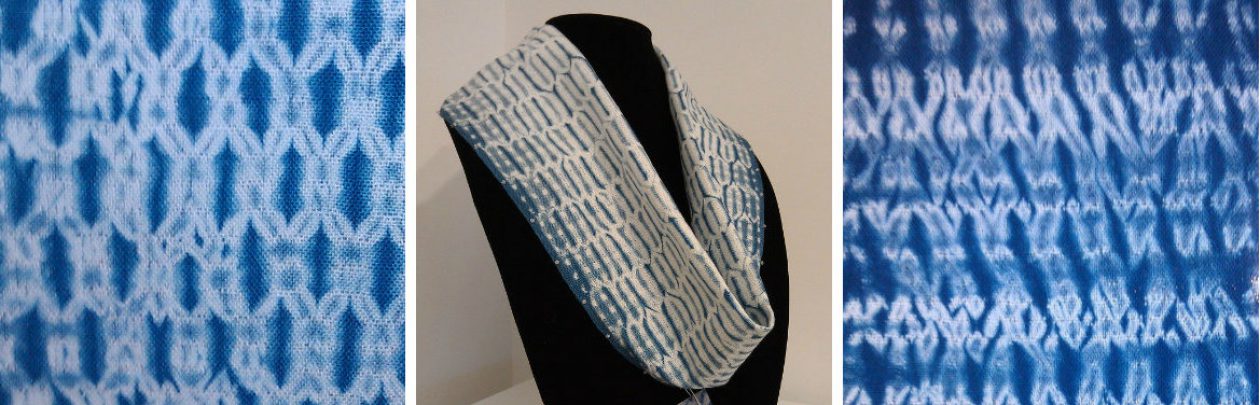
Woven shibori scarf in progress.

It’s been a long and very cold winter, and I will spare you photos of the last blizzard.  It’s also been a period when I wasn’t feeling 100%, and more than anything wanted to hibernate, and often did.

Perhaps spring is on the way?  I want to weave, and am back working on a somewhat narrow warp for woven shibori scarves (above).  This scarf is being treadled randomly and the number of plain weave rows between each “pattern” row also varies. 16/2 Bockens cotton, sett 30 epi, and I’m using a neutral color of rug warp for the pattern rows which are removed after dyeing with indigo. Stay tuned to see the finished scarves!
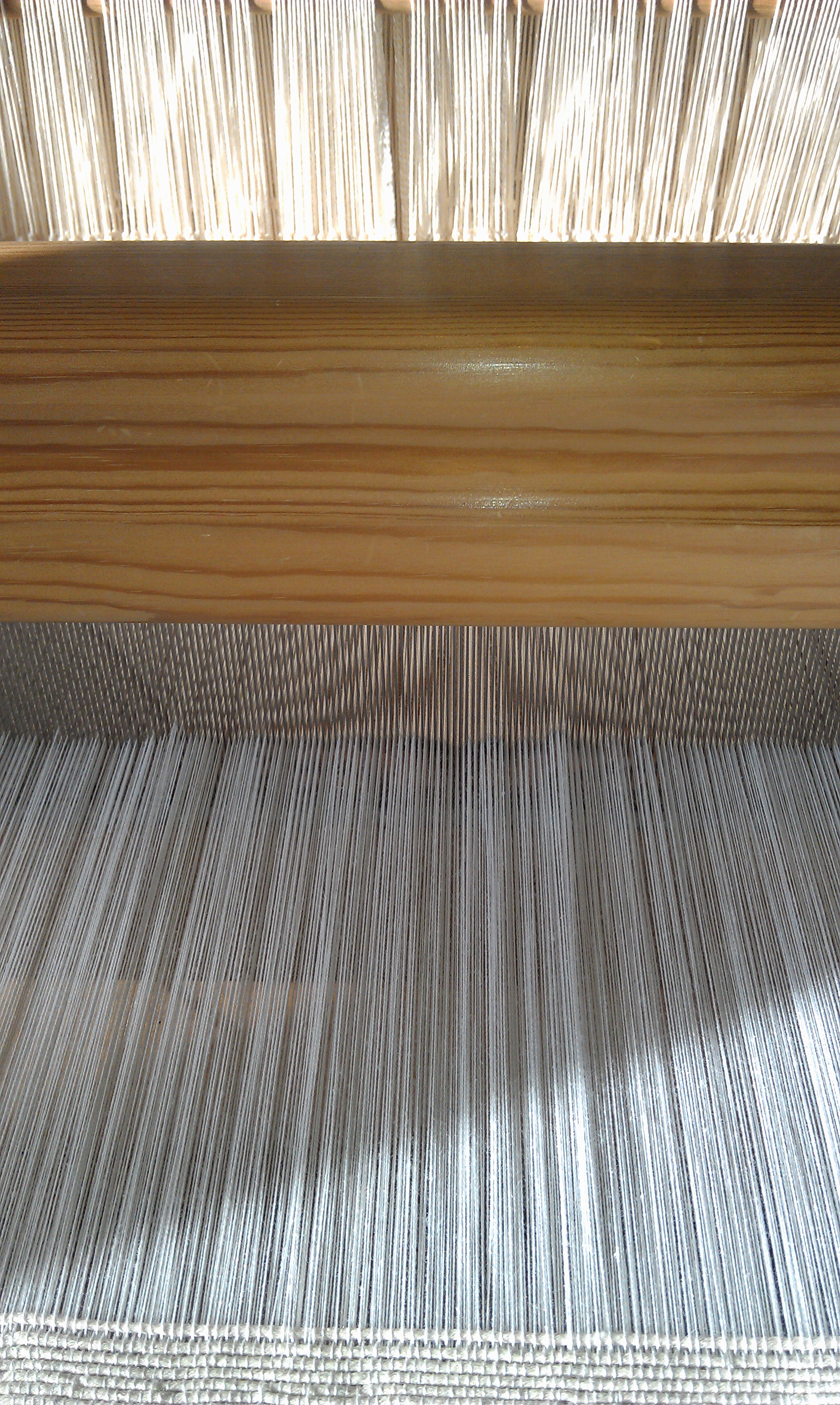
Drawloom warp is threaded, sleyed and tied on, ready to weave.

If I remember correctly this is a 20/2 cotton warp, sett 64 epi for 5 shaft (ground) satin.  The warp is spread and I’m ready to begin weaving.  Time to locate a chart I’d like to weave, to begin, then dig out designs I was working on, simplified from photos I took in China years ago.  I still need to transfer (and possibly enlarge a bit) to graph paper.

Glimakra "Sara" loom.
Glimakra “Sara” loom.

The Glimakra “Sara” upright tapestry loom is a simple frame-type loom, tall, on legs, adjustable weaving length, and has hard plastic “teeth” top and bottom to wrap yarn on.  This loom can be warped at 5 epi or 10 epi.  I may regret it, but I warped it at 10 epi with bleached 12/6 seine twine after finding the linen I was going to use was a bit too wide/coarse for that sett.  It is warped in two sections for a tapestry daily calendar.  I had decided to try this in February, then promptly came down with a head cold.  Now, I can either make up the weaving, or start March 1st.

The idea of a tapestry diary or daily calendar is to weave a small bit each day which is appealing and doesn’t feel overwhelming.  I’ve been debating with myself over how to approach this weaving,… vertical or horizontal?  A particular shape (square, rectangle, trapezoid)?  Freeform?  Color approach?  I do know this will also be a good way to learn and experiment with tapestry techniques, and color.  It’s time to sit down at the loom and take the first step, then I’ll be asking myself what took so long.

Behind the “Sara” loom in the photo above is the new-to-me “Regina” tapestry loom.  Part of the studio was rearranged to make a nice home for it, lights will be installed shortly, and I’m waiting for a new 8 dent stainless steel reed to arrive, again, from Gowdey Reed Company in Rhode Island.

The pace of life is about to pick up.  My younger daughter’s wedding is in two weeks.  We’re hoping the weather will begin to warm up a bit in early April so we can begin refinishing floors, then treating the log walls.  Our first seed order arrived and very soon we’ll be setting up and “fencing” a table in the basement where we can start seeds (and keep the cats out!).  After the snow has melted and frost is out of the ground, we’ll set up raised beds, put up fencing, and plant vegetable and flower gardens.  We’re planning to add bees next year.

And while all those projects are going on, the weaving must continue, and we’re finally going to add the opphamta attachment to my Standard loom, something I’ve been waiting years for.

In addition to the Northwoods Art Tour, and one or two open studio days of our own, I’ll again participate in a show with the Art Gypsies.  A busy and exciting year coming up!

New Weaving Adventures Ahead!

Things have been quiet in the studio the past month or so, between the winter blahs, and waiting for a reed to arrive. One evening I was thinking the seine twine heddles on the drawloom were a bit too heavy for the dense sett, and the next morning I had a note from another weaver saying she had experienced the same thing and perhaps I needed to make them from something a bit finer.  I would need to order a bit finer seine twine.

While on the computer looking up seine twine sizes, I decided to look at the GlimakraUSA used loom page. Not long after I first learned to weave (1981) I’d seen a Glimakra catalog and decided someday I would have a Glimakra Regina (vertical) tapestry/rug loom. A few years later they stopped production of that loom. I was so disappointed but thought perhaps someday I would find one.

I’ve been watching used loom lists for years, but that loom seems to be somewhat rare here and they were always far away and would cost hundreds more for shipping, so I kept waiting and hoping.

The day I looked again, there were a couple for sale, one in AZ, another further away. Going down the list there was another,… an HOUR away from my home, and looking at the email address realized it was Carol, one of our guild members.  Picking up the phone, I called her right away, asked questions, and agreed to buy it.

Glimakra Regina loaded into my car.

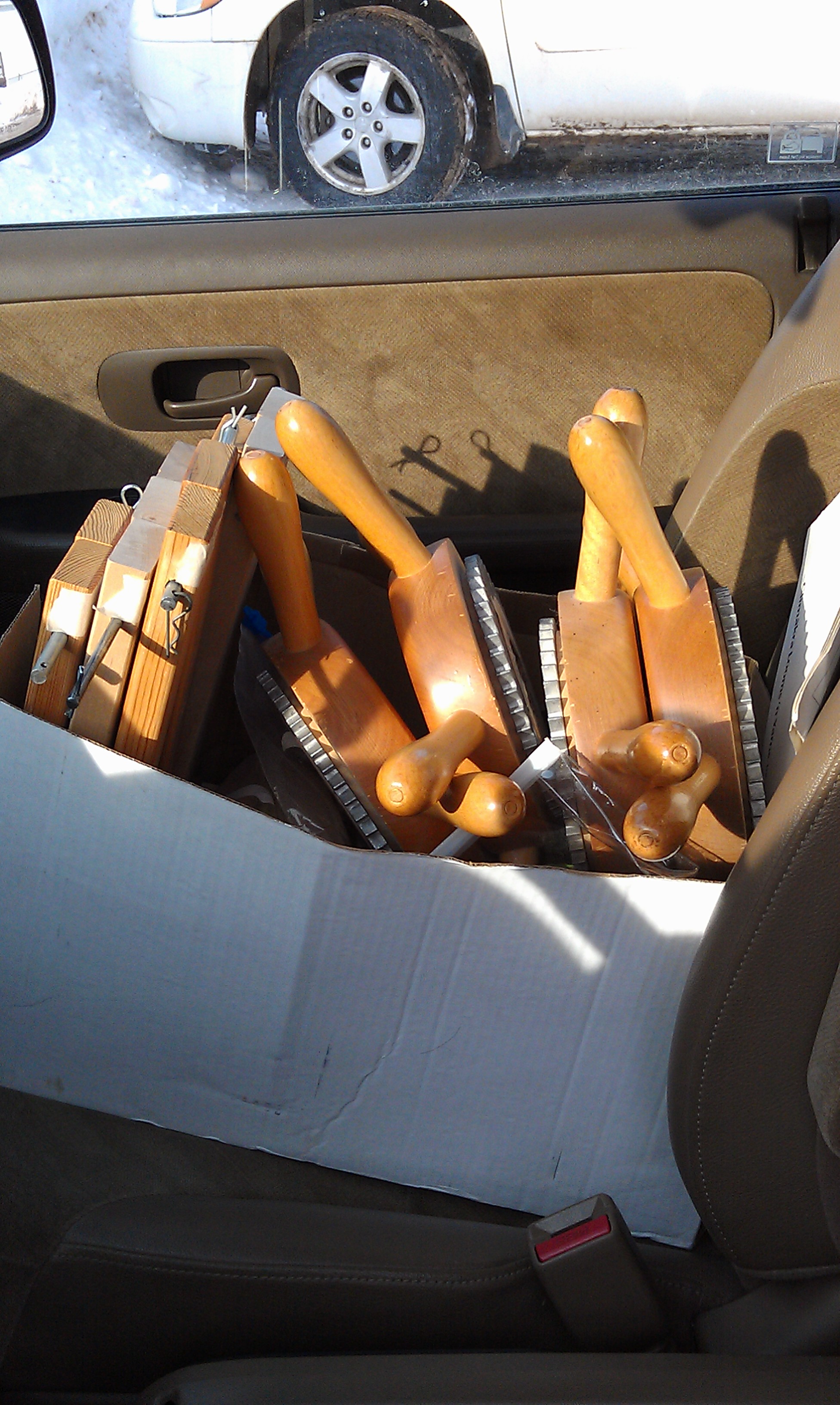
A few days ago I drove over and we were able to load all the pieces up into my car.

Box with ratchets, treadles and wedges.

On the front seat was the box holding the treadles, ratchets, wedges, and instructions for both loom assembly and warping.  The loom is 60″ wide and has 3 sets of treadles.

The loom had a few extra parts, as Carol had had a woodworker make extra shafts and treadles so the loom could be used as a 4 shaft loom.  They will be useful in the future, but to start I’ll be using the loom’s original two shafts.

Glimakra Regina (vertical) tapestry/rug loom, now assembled in the studio.

On Saturday, with Char’s help, the loom was assembled. My preference for reeds is stainless steel reeds, the reed that came with the loom wasn’t, so on Sunday, I was back online ordering a new 8 dent 60″ 8 stainless steel reed from Gowdey Reed Company in Rhode Island.  I’ve ordered from them before and their reeds are well-made and strong.

Needless to say, I’m excited to finally have this loom and very excited about the possibilities!  And Carol is VERY happy the loom was going to my home studio.

Now, I need to decide between starting with a tapestry sampler or a Scandinavian style Rana, and get warp and weft ordered.  Since I am starting a tapestry diary on the Glimakra “Sara” loom, and have a tabletop Schacht in reserve for starting to learn tapestry techniques, the thought of weaving a Rana is highly likely. Examples of Ranas may be found in “43 vavar av En enda varp” by Leena Svensson; “En annan bild av Lappland” by Doris Wiklund; and “Old Swedish Weavings from North to South” also by Doris Wiklund.

Carol and I are also going to partner up and be our own weaving study group as our area guild members prefer social meetings only. We’re exchanging emails detailing our weaving interests to find topics we would both want to learn and spend time on. More to look forward to!

Now, down to work in the studio, so I can get back to sharing photos of weaving!